
This is the article to print out and take with you when you talk to a steel building supplier. These are the questions to ask steel building supplier reps before you sign anything. Every question on this list matters, and the answers will tell you whether you are dealing with a reputable company or someone who is cutting corners at your expense.
What questions should I ask a steel building supplier? These 25. You do not need to ask all of them in the first phone call. But before you sign a contract or put down a deposit, you should have answers to all of them. If a supplier dodges, hedges, or cannot answer any of these, that tells you something. If you want help running these questions past a supplier before you commit, call us at (888) 460-9294. We will tell you what the answers should look like.
25 Questions To Ask Steel Building Supplier Before You Sign
Framing and Structure
1. Is this a solid-frame or tube-frame building?
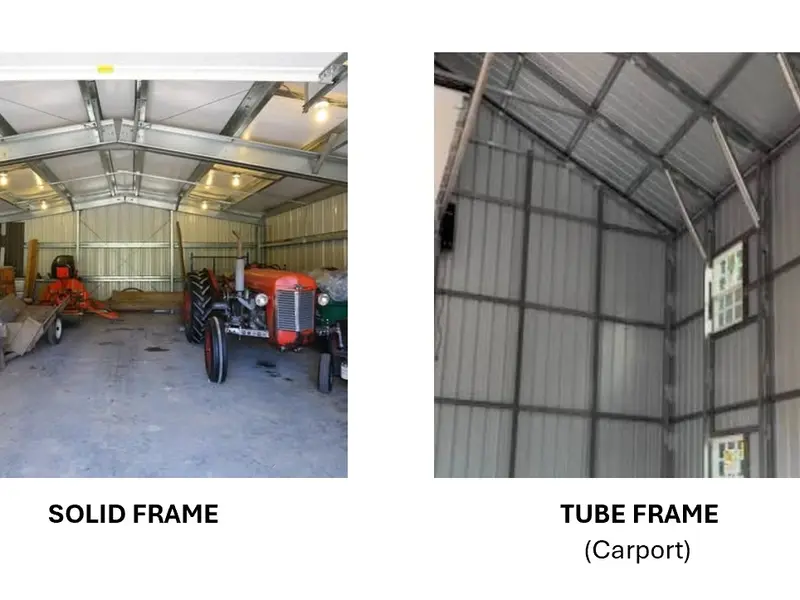
There are three types of steel building framing you will encounter, and they are not interchangeable. C-channel (cold-formed steel sections) is the standard for residential garages, workshops, and barndominiums. I-beam is for commercial and large clear-span applications — both C-channel and I-beam are solid-frame construction. Tube-frame buildings are the cheapest option, built from hollow steel tubing, and are really just carports and basic shelters. If the supplier cannot tell you which type they are quoting, that is a problem. We compare solid-frame and tube-frame in detail in our Solid Frame vs. Tube Frame article.
2. What size are the primary framing members?
For I-beam buildings, the answer should be specific beam designations (W8x18, W10x30, etc.). For C-channel buildings, it should be the section size and gauge (C4x2.5, C6x2.5, 12-gauge, etc.). For tube-frame, it should be tubing sizes (2x2, 4x4, etc.). If they cannot tell you, they do not know what they are selling.
3. What gauge is the secondary framing?
Secondary framing (purlins and girts) should be 16-gauge or heavier for quality buildings. 18-gauge or 20-gauge is lighter and cheaper. The gauge affects the stiffness and longevity of the building. For a full breakdown of what separates quality framing from cheap framing, see our article on Steel Building Quality.
4. What steel grade is used for the primary framing?
The answer should be A992 (50 ksi yield strength) for structural I-beam buildings. For C-channel buildings, the yield strength should be 55,000 psi minimum. A36 (36 ksi) is lower grade. If they do not know or say “standard,” ask them to find out.
5. What is the clear span width?
This is the distance between columns. For I-beam buildings, it should be the full width of the building, up to 100 feet. For C-channel buildings, it should be up to 40 feet. For tube-frame, it is typically limited to 24 feet. If there are interior columns, the clear span is less than the building width.
Engineering
6. What wind load is the building engineered for?
You want a specific number in mph, including the exposure category (B, C, or D) and gust type (3-second gust is standard). “Code minimum” or “standard” is not an answer. The number should meet or exceed your local building code. Solid-frame buildings can be engineered for 130 mph or higher. Tube-frame buildings are typically rated for 90 to 110 mph, which may not meet code in your area.
7. What snow load is the building engineered for?
You want the roof snow load in psf, not the ground snow load. Ground snow load is adjusted downward for roof applications. If they quote ground snow load, ask for the roof snow load after exposure and thermal factors. A building engineered for 30 psf roof snow load has more steel in the roof framing than one engineered for 20 psf.
8. What seismic design category is the building engineered for?
If you are in a seismically active area — the Cascadia zone covered on our Oregon and Washington state pages is a real example many buyers do not expect — this matters. The building should be engineered for your seismic zone. If the supplier does not mention seismic design, ask.
9. Are the engineering drawings stamped by a licensed engineer in my state?
The drawings should be stamped and signed by a professional engineer licensed in the state where the building will be erected. If the supplier cannot provide stamped drawings, you may not be able to get a building permit. For more on why permits matter, see our Steel Building Buyer’s Guide.
10. Can the building be re-engineered if my local code requires different loads?
Sometimes local codes require higher loads than the standard building design. The supplier should be able to re-engineer the building for your specific location, usually for an additional fee. If they cannot or will not, find a different supplier.
Coatings and materials
11. Are the wall and roof panels Galvalume AZ55-coated?
This is a yes-or-no question. If the answer is “painted” or “powder-coated” without Galvalume, you are getting a lower-quality coating. Read our Galvalume AZ55 article for why this matters, especially in humid or coastal climates.
12. Is the secondary framing also Galvalume-coated?
This is the hidden difference between quality and cheap buildings. Panels can be Galvalume while secondary framing is bare or painted steel. Ask specifically about the secondary framing coating. If they say “painted” or “primed,” the secondary framing will corrode inside the building where you cannot see it.
13. What gauge are the wall and roof panels?
26-gauge is standard for quality buildings. 29-gauge is thinner and cheaper. The difference is about 40% in steel weight. Thinner panels dent easier, oil-can more, and have lower fastener pull-out values.
14. What paint system is used on the panels?
Silicone-modified polyester (SMP) is standard. Valspar is premium. If the supplier does not know the paint system, that is a red flag.
15. What is the panel profile, R-Panel or PBR-Panel?
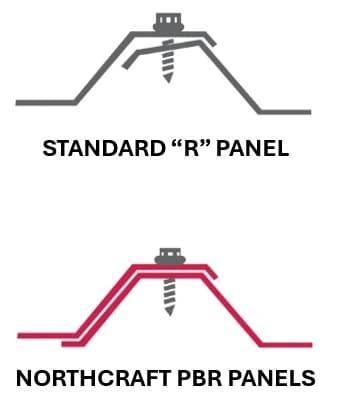
R-Panels have less of an overlap than PBR-Panels, which causes the R-Panels to leak more frequently. PBR (Purlin Bearing Rib) with 1-1/4 inch major ribs is standard for steel buildings. Lower-profile panels shed water less effectively on low-pitch roofs.
Warranty
16. What is the structural warranty on the primary framing?
10 years is the minimum acceptable. 25 years is better. Lifetime is best, but read the exclusions. A steel building warranty that excludes “normal weathering” or “improper installation” is worth less than it sounds.
17. What is the perforation warranty on the panels?
For Galvalume panels, 25 years is standard. Some manufacturers offer 35 to 40 years. The warranty should cover perforation due to corrosion, not just cosmetic rust. Perforation means the steel has rusted through, not that the surface has changed color.
18. What is the finish warranty on the painted panels?
20 to 40 years is standard. The warranty should cover fading, chalking, and cracking of the paint film. Check the exclusions for UV exposure and chemical contact.
19. Can I see the full warranty document with all exclusions before I buy?
If they will not provide the warranty document before purchase, do not buy. A warranty summary is not the warranty. You need the actual document with all terms and exclusions. A one-page warranty with no exclusions listed is usually worthless because the company can decide what is covered after the fact.
20. Is the warranty transferable if I sell the property?
Some warranties are transferable, some are not. If you plan to sell the property within the warranty period, a transferable warranty adds value. If the warranty is non-transferable, it dies when you sell.
Installation and delivery
21. Does the price include delivery?
Some quotes include shipping, some do not — Northcraft's starting prices include freight to your site. Ask any other supplier you're comparing whether theirs do too before comparing prices. For a full framework on comparing quotes, see our Quote Comparison article.
22. Does the price include installation?
If installation is included, ask who does the work. Are they employees of the manufacturer or subcontractors? Are they licensed and insured in your state? What happens if there is an installation problem? A building installed poorly will perform worse than a mediocre building installed correctly.
23. What foundation do I need, and can you provide foundation drawings?
The supplier should provide a foundation reaction diagram showing the loads at each column base. Your concrete contractor needs this to design and pour the foundation. If they cannot provide it, find a different supplier. The foundation is part of the structural system, not an afterthought.
Accessories and pricing
24. What accessories are included in the quoted price?
Make a list: overhead doors, walk doors, windows, insulation, vents, gutters, skylights, trim. Compare what is included across quotes. A lower price that excludes doors and insulation is not cheaper once you add those items. This is where a lot of buyers get surprised. They see a great price, sign the contract, and then discover that walk doors, windows, and insulation are extra. By the time they add everything they need, the price has gone up 30%.
25. What is the total delivered price with all accessories and options?
This is the number that matters. Ask for a written quote that includes the building, all accessories, engineering, delivery, and installation (if applicable). No “base price plus options.” You want the bottom-line number for a complete, erected building. For a detailed breakdown of what drives steel building pricing, see our Steel Building Cost article.
How to use this checklist
Print this list. Take it to every conversation with a steel building supplier. Write down the answers. If a sales rep cannot or will not answer a question, write that down too. A pattern of “I’ll have to get back to you on that” or “That’s standard” without specifics tells you everything you need to know about the company.
What to ask before signing a steel building contract? Every question above. How to vet a steel building company? By whether they answer these 25 questions clearly and without hesitation. Reputable suppliers will answer these questions without hesitation. They know their products, they know their engineering, and they know that an informed buyer is their best customer. If a supplier gets defensive or impatient with these questions to ask steel building supplier reps, they are not someone you want to trust with a five-figure investment. That is what questions to ask steel building supplier conversations are designed to surface.
And if you want to run the answers by someone who has no stake in which building you buy, call us at (888) 460-9294 or email estimating@northcraftsteel.com. We will tell you what the answers mean and whether anything looks off. No charge, no pitch, just a straight read on what you are being sold.