
RV & Boat Storage Steel Buildings, Engineered to Protect What You Own
Enclosed garages, dock shelters, and roof-only covers — sized to your tallest unit and built for real weather, not a generic carport.
Built for decades. Backed in writing.
50-Year Paint Warranty, 50-Year Rust Perforation Warranty, 60-Year Structural Warranty, and Lifetime Warranty on Hardware — all transferable to the next property owner.
Get Your Customized Quote
- No obligation — we’ll send the price, not a salesperson to your door.
- Engineered drawings stamped for your state.
- 60-Year Limited Structural, 50-Year Limited Paint, 50-Year Limited Rust Perforation, and Lifetime Limited Hardware warranties.
- Delivered nationwide, all 50 states.
Custom Engineering • Any Dimension • Code Compliant • Nationwide Delivery
RV & Boat Storage Steel Building Price
$21,300 and up
C-channel framing, 10’ eave height basis, standard snow and wind loads.
Covers common RV and boat storage sizes from a 30x60 building up to a 40x80 multi-unit building.
Included
- • Stamped, engineered building drawings for your state
- • All primary building components
- • Freight to your site
Not included
- • Doors and windows
- • Insulation
- • Concrete or foundation work
- • Erection
Building specs
- • Framing type: C-channel solid frame, 10-16 gauge steel
- • Roof / wall panels: 26-gauge and heavier available
- • Roof pitch: Up to 8/12
- • Coating: Galvalume AZ55 on all primary and secondary framing
- • Hardware: Stainless steel hardware with a neoprene washer
- • Trim package: Full trim package included
What moves the price
- • Eave height above the 10’ basis
- • Ground snow load above 35 psf
- • Wind load above 110 mph
- • Areas with high seismic activity
This is a starting price, not a binding quote — your exact number depends on your state’s code requirements, site conditions, and what the building has to carry. We confirm the real number with stamped engineering before you sign anything.
Storage Steel Buildings For
RV & Boats
Common size ranges matched to typical use cases — a starting point for scoping your engineered building.
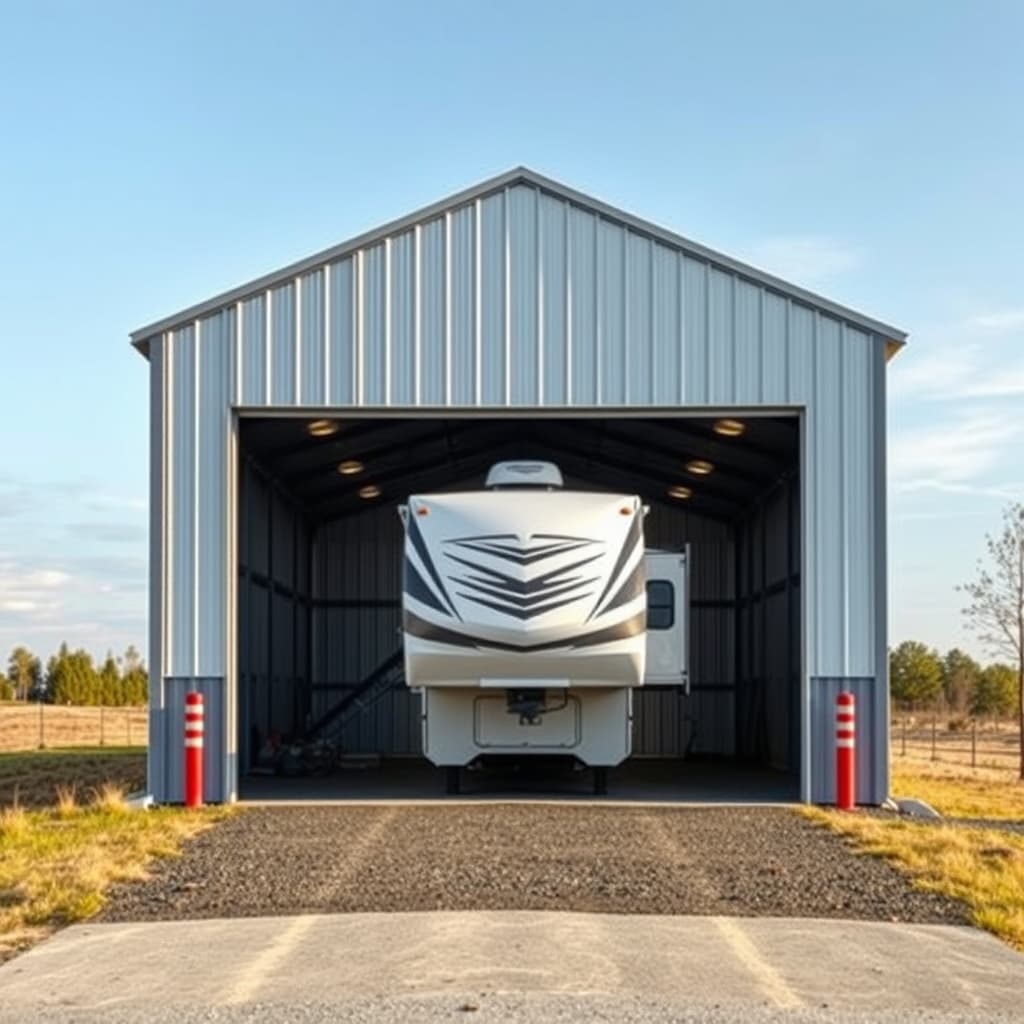
RV Garages
Fully enclosed and insulated for year-round protection. Heated, climate-controlled space with oversized doors — ideal for premium motorhomes and liveaboard access.
Dock Shelters
A roof only dock shelters for any of your boating needs while spending at the dock.
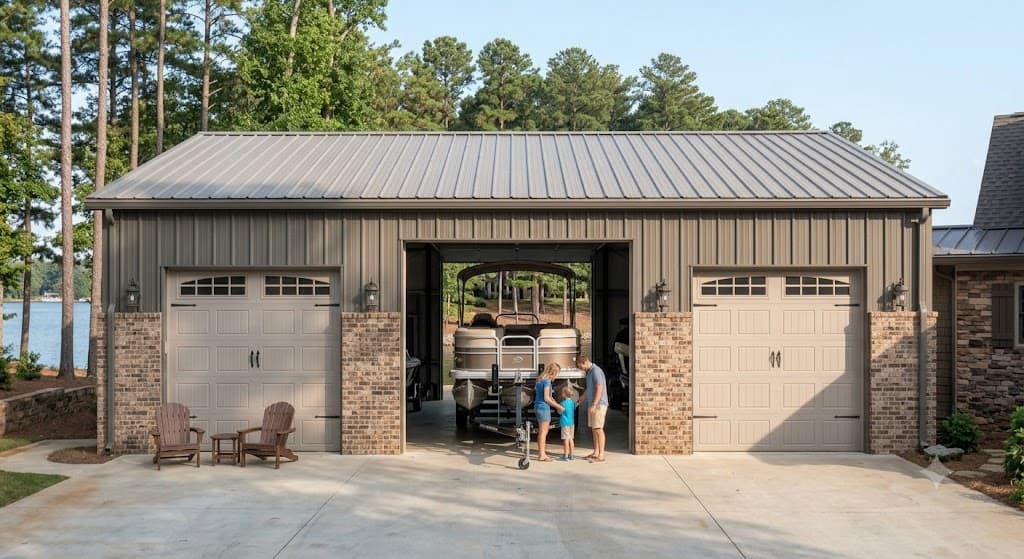
Boat Storage Buildings
Enclosed, climate-controlled buildings engineered for boats up to large cabin cruisers. Humidity control protects hulls, electronics, and upholstery.
The Door Is the Real Spec, Not the Floor Plan
For RV and boat storage, the door decides whether the building works, not the square footage. Measure your tallest unit including roof-mounted air conditioners, vents, satellite domes, and antennas — not the manufacturer’s advertised vehicle height — and engineer the door and clear height around that real number, with margin for whatever you might add later. Changing door height after the building is engineered costs far more than specifying it correctly up front.
Occupancy Still Matters, Even for a Storage Building
It’s tempting to assume a storage-only building always gets the lightest possible engineering treatment, but that depends on how it’s actually used and accessed — an unattended building where owners drop off and retrieve their own units infrequently is a different case from a staffed rental facility with regular public access. Tell your estimator honestly how your building will be used and who has access, rather than assuming “storage” settles the question by itself.
Coastal Storage: What’s Already Built In, and What Isn’t
Salt air and humidity are real concerns for boat owners storing near the coast. Northcraft’s standard specification already addresses the building itself — every steel component ships with Galvalume coating, not an upgrade you have to request. What it doesn’t include automatically is interior climate control: ventilation or dehumidification for an enclosed boat garage is a real conversation to have with your estimator if your site sits directly on saltwater, separate from the building’s own coating.
What RV and Boat Storage Buyers Get Wrong
The most common mistake is designing the door around today’s vehicle instead of the tallest thing that will ever need to fit through it. The second is skipping the occupancy conversation because the building is “just storage” — say how it’s actually staffed and accessed, and let your estimator confirm what that means for the engineering.
From Engineering to Erecting
A streamlined three-phase process takes your steel building for your RV or boat storage from blueprint to standing structure.
STEP 1
Engineering & Fabrication
Every component is CAD-engineered to your specs and factory-fabricated to exact tolerances before it ships.
STEP 2
Concrete Foundation
A poured concrete foundation is prepared on your site to the engineered plan, ready to receive the steel frame.
STEP 3
Steel Erection
Pre-cut, pre-drilled components bolt together quickly — no welding in the field, no guesswork on the ground.
Backed By Real Warranties

YEAR LIMITED RUST WARRANTY

YEAR LIMITED PAINT WARRANTY

YEAR LIMITED STRUCTURAL WARRANTY

LIMITED HARDWARE WARRANTY
All four warranties are transferable to the next property owner. Every building ships with code-compliant stamped engineering for the delivery state. See full warranty terms.
* Warranty coverage is subject to applicable warranty terms, conditions, limitations, and exclusions. Complete warranty details are provided during the purchase process and included within the applicable purchase documentation.
Frequently Asked Questions
What does an RV or boat storage building cost?
Northcraft's published floors for common RV and boat storage sizes start at $21,300 (a 30x60 building), delivered, and scale up in size through a 40x80 multi-unit building. Your estimator confirms the exact floor for your actual dimensions and door height.
Is an RV or boat storage building C-channel or I-beam?
Every size in this range is C-channel framing on a 10-foot eave basis. Door height matters more than frame type here — tell your estimator your tallest unit's height so the clearance is engineered correctly.
Do I need a permit for RV or boat storage?
Most jurisdictions require a permit, even for a storage-only building with no plumbing or occupancy. We provide the stamped engineering drawings your local building department will ask for.
Can the building be customized for our door heights and unit sizes?
Yes. Every Northcraft building is fully customized to your exact specifications — this isn't a catalog of fixed sizes. Tell us your tallest RV or largest boat's dimensions and how many units you need to store, and we engineer to those specs instead of a preset.
What's included in the price, and what isn't?
Included: stamped engineered drawings for your state, every structural and panel component, and freight to your site. Not included: doors and windows, insulation, concrete or foundation work, and erection — priced separately; those services are available. Plan your oversized door openings with your estimator before finalizing the configuration.
What loads does the published floor assume, and what raises it?
The floor is based on ground snow load up to 35 lb per square foot and wind speed up to 110 mph. Eave height above the 10-foot basis, higher snow or wind ratings, and high seismic activity all move the price.
How long does an RV or boat storage building take from order to delivery?
Most projects run 45-60 days from order to delivery, the same nationwide timeline as Northcraft's other building types. Your estimator confirms a real date once your door heights and unit count are finalized.
Should I build an enclosed garage or a roof-only cover?
It depends on what you're protecting and your budget. A fully enclosed, insulated RV garage or boat storage building gives year-round climate control; a roof-only RV cover or dock shelter costs less and still protects against sun and rain. Your estimator can price both once you know which fits your situation.
Does an unattended RV or boat storage building need less engineering than an occupied building?
Occupancy is still a real question, not an assumption you can skip. A storage-only building with no staff and rare, brief visits to drop off or retrieve a unit sits at the lighter end of ASCE 7's occupancy spectrum; a staffed self-storage or rental facility with regular public access is a different case. Tell your estimator honestly how the building will actually be used and accessed, rather than assuming 'storage' always means the lightest classification.
How do I pick the right door height if I store more than one RV or boat?
Measure your tallest unit including roof-mounted air conditioners, vents, and antennas — not just the vehicle's advertised height — and design the door and clear height around that number, with margin. If you plan to add a taller unit later, tell your estimator now; door height is far more expensive to change after the building is engineered than before.
Does coastal humidity or salt air change what building I need?
It's a real consideration for boat storage near the coast, and it's already addressed in Northcraft's standard specification rather than an upgrade you have to ask for separately: every building ships with Galvalume coating on its steel components (see the building specs in the price band above). Beyond the building itself, ventilation and any dehumidification for an enclosed boat garage are worth discussing with your estimator if your site sits directly on saltwater.
Build Your RV & Boat Storage Steel Building Right.
Buy once. Build it right. Get a custom-engineered quote for your custom steel building — no obligation.
Call: (888) 460-9294 | Email: Estimating@Northcraftsteel.com
Get Your Customized Quote