
Most people buying a steel building get three or four quotes, line them up side by side, and pick the one with the lowest number at the bottom. That is the worst way to do it.
A steel building quote is not like a quote for a car or a piece of furniture. Two buildings with the same dimensions can be built to completely different standards, with different materials, different engineering, and different warranties. The price difference between them reflects real differences in what you are getting. If you do not understand those differences, you will end up with a building that is either overpriced for what it is or under-engineered for what you need.
Here is how to compare steel building quotes the right way. If you want someone to look over your quotes with you, call us at (888) 460-9294. We will tell you what we see, no strings attached.
Start With The Building Dimensions And Specs
Before you compare steel building quotes, make sure the quotes are for the same building. That sounds obvious, but you would be surprised how often they are not.
Check the dimensions first. Is the quoted dimension the outside footprint or the inside clearance? Some manufacturers quote outside dimensions, which means your inside clear height and width will be several inches less once you account for the framing and panels. Others quote inside dimensions. A 40x60 building quoted outside is not the same as a 40x60 building quoted inside.
Check the eave height. That is the height of the wall where it meets the roof. A building with a 12-foot eave height gives you more usable interior space than one with a 10-foot eave, and it costs more. If one quote has 10 feet and another has 12 feet, the price difference is not just about quality, it is about size.
Check the roof pitch. A 1:12 pitch (one inch of rise per foot of run) is the minimum for through-fastened panels. A 4:12 pitch sheds snow better and looks better but costs more in material. Different pitches mean different amounts of steel, which means different prices.
If the dimensions, eave height, or roof pitch are different across quotes, you are not comparing the same building. Normalize them first. Ask each supplier to quote the same specs so you are comparing apples to apples.
Compare The Engineering
This is where most buyers lose money without realizing it, and it is the core of comparing steel building quotes.
Every steel building quote should specify the design loads the building is engineered for. The key numbers are wind load (in mph), snow load (in pounds per square foot or psf), exposure category (B, C, or D), and seismic design category. If these numbers are not on the quote, ask for them. If the supplier cannot provide them, you have a problem.
Here is what to look for:
Wind load rating should be specific. “Code minimum” is not a number. You want something like “115 mph, exposure C, 3-second gust” — which happens to be the real published design wind speed on our Nebraska state page, not a made-up example. If you are in a coastal area or a high-wind region, your building needs higher ratings. A building engineered for 90 mph wind is not the same as one engineered for 130 mph, and the price reflects the difference in steel.
Snow load rating should also be specific. “20 psf ground snow load” is not the same as “20 psf roof snow load.” Ground snow load gets adjusted by exposure and thermal factors to arrive at the roof snow load. A building engineered for 30 psf roof snow load has more steel in the roof framing than one engineered for 20 psf.
The important thing is that all your quotes use the same load values. If one quotes 90 mph wind and another quotes 130 mph wind, the 130 mph building should cost more. If the 90 mph building costs the same or more, something else is going on.
Compare The Framing
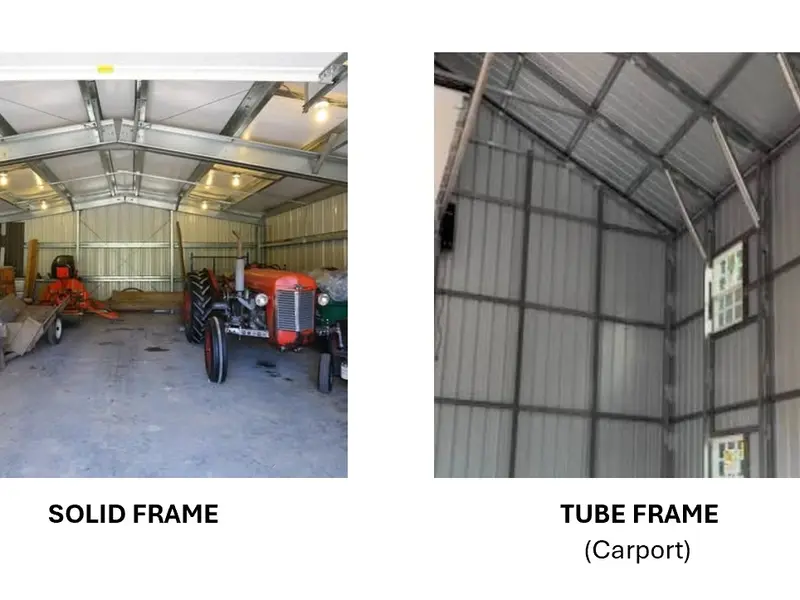
Primary framing is the main structural frame. For residential and light commercial buildings, this is typically C-channel (cold-formed steel sections). For larger commercial buildings, it is I-beam (heavy structural beams). Both are solid-frame construction. For the cheapest buildings on the market, it is hollow tube steel — a separate category entirely. Your quote should specify which one you are getting. If it says “steel framing” without specifying the type, ask. For a full breakdown of the differences, see our Solid Frame vs. Tube Frame article.
For I-beam buildings, the primary framing should be specified by beam size (W8x18, W10x30, etc.) and yield strength (50 ksi is standard for A992 steel). If the quote does not specify the beam size, ask. A building with W8x10 beams is not the same as one with W10x30 beams, even if the dimensions and loads are identical. The larger beam has more steel and costs more.
Secondary framing is typically cold-formed Z-purlins or C-girts. The gauge matters. 16-gauge secondary framing is heavier and stronger than 18-gauge or 20-gauge. Some manufacturers use lighter gauge framing to save money, and the building may still meet the minimum engineering requirements, but it will be less stiff and more prone to movement in high winds.
Ask about the bracing. Does the building use cable bracing, rod bracing, or portal frames? Cable bracing is the cheapest and least rigid. Rod bracing is better. Portal frames are the most rigid but also the most expensive. The type of bracing affects how the building performs in wind and seismic events.
Compare The Steel Panels
Wall and roof panels come in different profiles, gauges, and coatings. All three matter.
Profile refers to the shape of the panel. PBR (Purlin Bearing Rib) is the most common profile for steel buildings. It has a major rib height of 1-1/4 inches, which provides good structural performance and water shedding. Some cheaper buildings use lower-profile panels with shorter ribs, which shed water less effectively on low-pitch roofs.
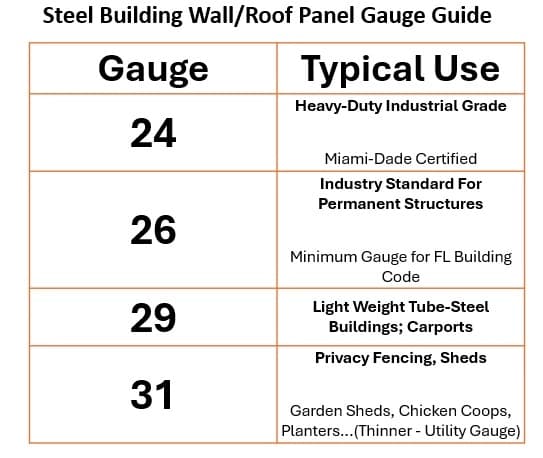
Gauge is the thickness of the steel. 26-gauge is standard for wall and roof panels. Some manufacturers use 29-gauge to save money. The difference is about 0.004 inches, which does not sound like much, but 26-gauge is 40% thicker than 29-gauge by weight. Thinner panels are more prone to oil-canning (visible waviness in the panel surface), denting from hail, and fastener pull-out.
Coating is the corrosion protection. We cover this in detail in our Galvalume AZ55 article, but the short version: you want Galvalume AZ55-coated panels for exterior surfaces. Painted steel without a Galvalume substrate will start rusting at scratches and cut edges within a few years. If the quote says “painted” but does not mention Galvalume, ask.
Compare The Warranty
Warranties vary enormously. A 25-year perforation warranty on Galvalume panels is industry standard for quality buildings. Structural warranties range from 10 years to lifetime. Panel finish warranties (paint fading and chalking) run 20 to 40 years.
But the warranty length is only half the story. The other half is the exclusions. A 40-year warranty that excludes damage from improper installation, chemical exposure, normal weathering, and modification is not as good as a 25-year warranty with fewer exclusions.
Ask each supplier for a copy of the actual warranty document, not a summary. Read the exclusions. Compare them. If one steel building warranty has significantly more exclusions, the building may be built to a lower standard and the manufacturer is protecting themselves against claims.
Compare What Is Included
This is where quotes get tricky. One quote may include walk doors, windows, and insulation. Another may list them as optional add-ons. The base prices may look different, but once you add the accessories you need, the prices may be similar.
Make a list of what you need: doors (walk doors and overhead doors), windows, insulation, vents, gutters, skylights, flashing trim, and any special framing for interior finishes. Then check what each quote includes.
Pay attention to insulation. If you plan to heat or cool the building, insulation is a big cost item. Fiberglass blanket insulation comes in different R-values (R-10, R-19, R-30). Higher R-value costs more. Some quotes include vapor barriers, some do not. If you need a conditioned space, you also need a vapor barrier to prevent condensation inside the insulation.
How To Compare Steel Building Quotes The Right Way
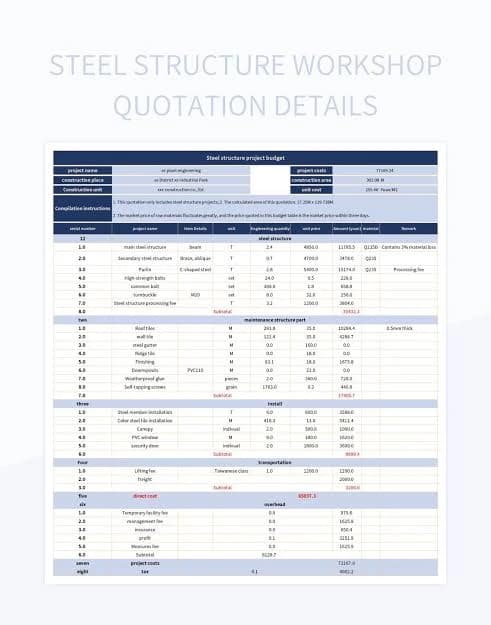
Here is a practical framework to compare steel building quotes. Create a spreadsheet with these rows so you can compare steel building quotes line by line. Before you compare prices, make sure the quotes are for the same building. That sounds obvious, but you would be surprised how often they are not.
Building dimensions
Eave height
Roof pitch
Wind load (mph, exposure category)
Snow load (psf, roof or ground)
Primary framing size and yield strength
Secondary framing gauge
Panel profile
Panel gauge
Panel coating (Galvalume AZ55 or other)
Bracing type
Warranty (structural, panel, finish) with exclusions noted
Included accessories (doors, windows, insulation, vents, gutters)
Total price
Price per pound
Fill in each row for every quote. When you are done, you will see exactly where the quotes differ and why. The cheapest quote will stand out in specific categories: lighter framing, thinner panels, lower wind load, shorter warranty, fewer accessories.
That is the quote you should be worried about.
Red Flags In Steel Building Quotes
Watch for these red flags in steel building quotes when comparing:
A quote that is 30% or more below the others. Nobody is selling steel that cheap. Something is missing, probably in the engineering, the panels, or the warranty.
A quote with no specified wind or snow load. This means the building is engineered to some generic standard, not your local code. You may not be able to get a permit.
A quote with “standard warranty” and no details. Ask what that means. If they cannot produce the warranty document, assume there is no meaningful warranty.
A quote that pressures you to sign today. Reputable suppliers give you time to compare. The urgency tactic is designed to prevent you from doing the comparison we just described.
A quote from a company that cannot provide stamped engineering drawings. If they cannot stamp the drawings, the building may not be engineered at all. It may just be fabricated to a generic pattern.
What should be in a steel building quote? Everything above. If a supplier will not give you the details to fill in the spreadsheet, they are not a supplier you want to work with.
The Bottom Line On Comparing Quotes
The right question is not “which quote is cheapest?” The right question is “which quote gives me the most building for my money?” Sometimes that is the cheapest quote. Most of the time it is not.
Take the time to compare line by line. When you compare steel building quotes properly, the differences show up in specific categories — framing gauge, coating, wind load, warranty terms. If a supplier will not give you the details you need to compare, they are not a supplier you want to work with.
For a full checklist of what to ask before you sign, see our 25 Questions article. And if you want someone to look over your quotes with you, call us at (888) 460-9294 or email estimating@northcraftsteel.com. We will tell you what we see, no strings attached.