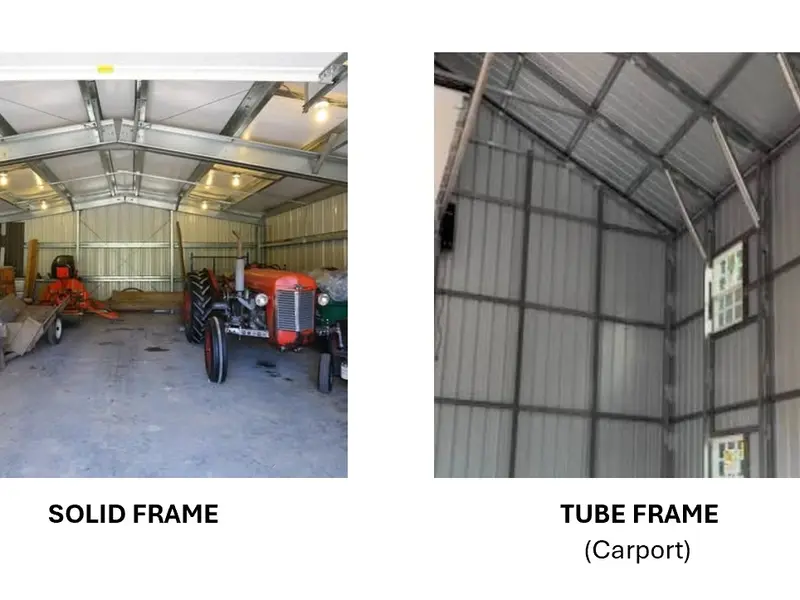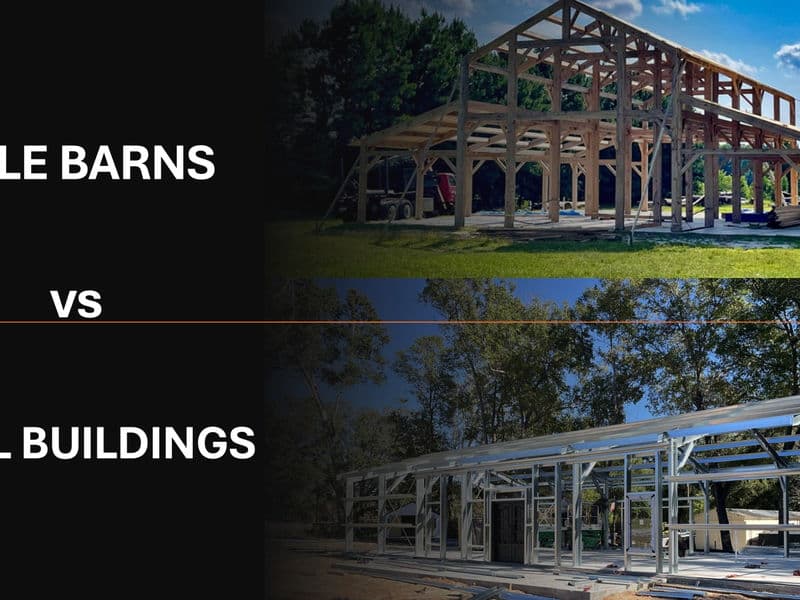

Let us say you have decided to buy an I-beam steel building. Good choice. You are already ahead of most buyers who get talked into tube-frame buildings and regret it later.
But here is the thing that surprises people: not all I-beam buildings are created equal. Two buildings with the same dimensions, same wind load rating, and same general appearance can be built to completely different standards. One might still be standing strong in 50 years. The other might start showing problems in 10.
What makes a quality I-beam steel building? The differences are in the details that most buyers never see and most sales reps never mention. We are going to cover them here so you know what to ask about. The same quality spectrum applies to C-channel buildings too, not just I-beam — both are solid-frame construction. If you are shopping for a residential building, read our Solid Frame vs. Tube Frame first, then come back here for the quality details. If you have questions about what to look for in your specific case, call us at (888) 460-9294.
What Separates A Quality I-Beam Steel Building From A Cheap One
Steel rusts. Every manufacturer knows this, and every manufacturer has a different approach to dealing with it. The cheapest approach is to do nothing. The steel is fabricated, painted with a primer, and sent out. That building will start rusting at every scratch, cut edge, and bolt hole within the first few years.
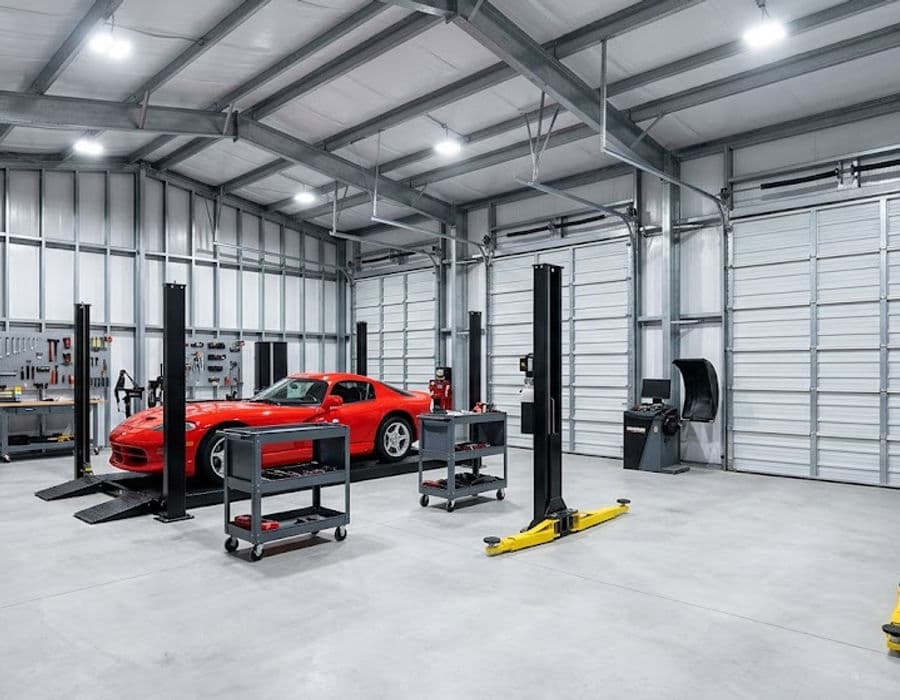
The best approach is Galvalume coating on the steel substrate. Galvalume is an aluminum-zinc alloy coating applied during the steel manufacturing process, before the steel is fabricated into building components. The aluminum provides a barrier layer, and the zinc provides galvanic protection at cut edges and scratches where the coating is damaged.
The difference matters most on secondary framing. Secondary framing (purlins and girts) is the steel that supports the wall and roof panels and transfers loads to the primary I-beam frame. It is exposed to condensation, humidity, and in some buildings, direct moisture. If the secondary framing is bare steel with paint, it will corrode. If it is Galvalume-coated, it will resist corrosion for decades. For a full explanation of how Galvalume works, see our Galvalume AZ55 article.
Here is what surprises people: some manufacturers use Galvalume-coated panels but bare or painted secondary framing. The panels look great, but the purlins and girts underneath are rusting where you cannot see them. By the time the problem is visible from outside, the secondary framing has lost significant structural capacity.
What to ask about steel building coatings? Ask your supplier specifically about the coating on the secondary framing. Not just the panels. If they say “painted” or “primed” for the secondary framing, you are looking at a building that will have hidden corrosion problems. Galvalume-coated secondary framing costs more, but it is one of the biggest determinants of how long your I-beam steel building will last.
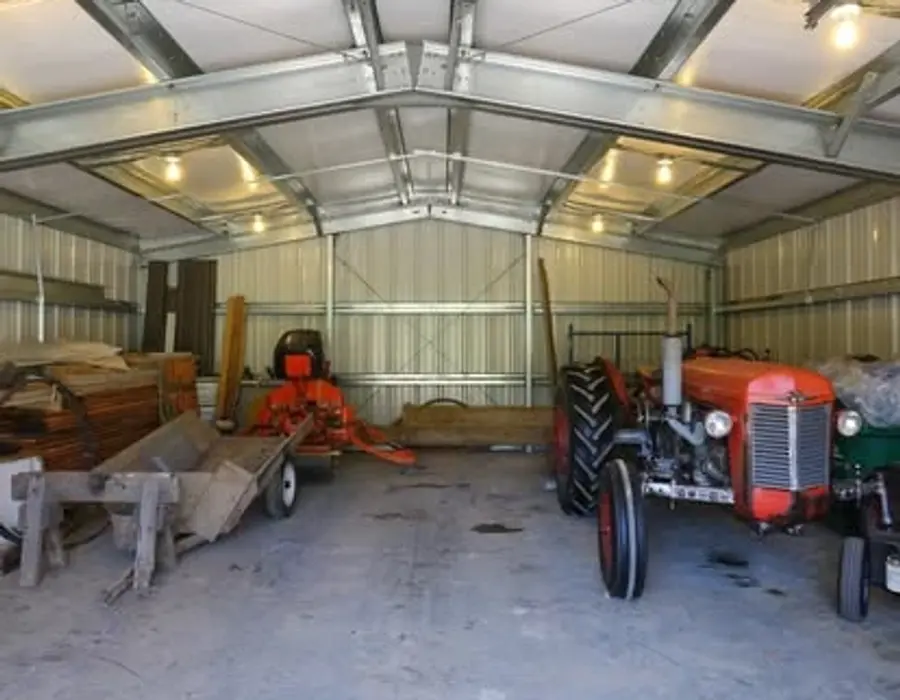
“R” vs “PBR” Wall & Roof Steel Panels
PBR (Purlin Bearing Rib) steel panels offer a significant structural advantage over standard R panels due to their extended overlap leg. This extra lip creates a full-height bearing leg that rests directly against the structural purlin beneath the overlap seam.
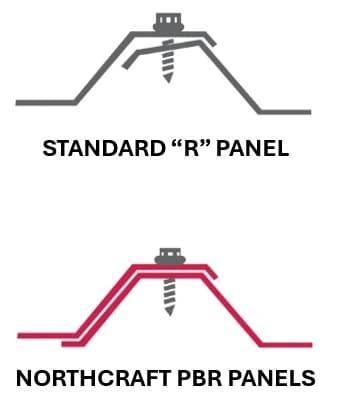
While both profiles share a similar 12-inch rib spacing, the additional support in PBR panels creates a tighter weather seal, prevents moisture siphoning between sheets, and significantly improves structural strength against wind uplift and heavy snow loads. As a result, PBR panels reduce the risk of leaks around fasteners and deliver greater overall durability for industrial, commercial, and agricultural roofs.
Secondary Framing Gauge And Spacing
Secondary framing comes in different gauges (thicknesses) and is spaced at different intervals. Both affect the performance of the building.
Secondary framing gauge matters more than most buyers realize. 16-gauge secondary framing is heavier and stiffer than 18-gauge, which is heavier than 20-gauge. A building with 16-gauge secondary framing will be more rigid, resist wind deflection better, and provide a more solid feel inside. It also costs more because there is more steel in it.
Spacing: Purlins and girts are typically spaced 2 feet to 5 feet on center. Closer spacing means more framing members, which means more support for the panels and less panel deflection between framing points. Wider spacing saves money but can lead to panel waviness (oil-canning) and reduced wind resistance.
Some manufacturers reduce costs by using lighter gauge secondary framing spaced farther apart. The building still meets the minimum engineering requirements, but it will not perform as well in real-world conditions. Panels may flex more in the wind, fasteners may work loose over time, and the building will feel less solid.
Ask about the gauge and spacing of the secondary framing. A quality I-beam steel building will typically use 16-gauge or 14-gauge secondary framing at 2 to 3 feet on center. A cheaper building will use 18-gauge or 20-gauge at 4 to 5 feet on center.
Primary Framing: Not All Beams Are Equal
We talked about beam sizes in our Quote Comparison article, but there is another difference that buyers often miss: the fabrication quality.
I-beams used in steel buildings are either hot-rolled or welded plate. Hot-rolled beams (W-shapes) are produced at a steel mill to standard dimensions. Welded plate beams are fabricated by welding three plates together to form an I-shape. Both can be engineered to the same load capacity, but the fabrication process differs.
The difference that matters to you is the welding. In a welded plate beam, the welds between the flanges and the web are critical. If the welds are poor quality, they can fail under load. Look for beams that are welded to AWS (American Welding Society) standards with continuous welds, not intermittent welds.
Another thing to check is the connection design at the frame joints. The rigid-frame connection between the column and the rafter is where the building handles its highest stresses. Quality manufacturers use heavy end plates with multiple high-strength bolts. Cheaper manufacturers use lighter plates with fewer bolts. Ask to see a detail drawing of the frame connection. If it looks thin or has only a few bolts, ask questions.
Materials And Steel Grade
The steel used in an I-beam steel building should meet specific ASTM standards. A992 steel grade is the most common, with a minimum yield strength of 50,000 psi. Some manufacturers use A36 steel, which has a yield strength of 36,000 psi. A992 is stronger, which means less steel is needed for the same load capacity, but the steel itself costs more per pound.
If your quote does not specify the steel grade, ask. If the supplier says “standard steel” or does not know, you are probably getting A36 or whatever was cheapest at the mill that week. A992 steel grade is the industry standard for structural steel buildings, and any reputable manufacturer will specify it.
The same applies to the panel steel. Panels should be made from 55,000 psi minimum yield steel for structural performance. Lower-grade panel steel is more prone to denting, oil-canning, and fastener pull-through.
Fasteners And Hardware
This is a small detail that has big consequences. The steel building fasteners holding your building together determine how well it holds up in wind and over time.
Self-tapping screws used to attach panels should be stainless steel or coated carbon steel with EPDM washers. The washer seals the hole against water intrusion. Industry-standard fasteners use neoprene washers or no washers at all, and they eventually corrode over time. Once the fastener rusts, it fails, and the panel comes loose.
Structural bolts (the ones holding the I-beam frame together) should be A325 or A490 high-strength bolts. These are industry standard for structural steel connections. Some manufacturers use lower-grade bolts to save money. The structural bolts should be tightened to a specific torque, not just snugged by hand.
Ask about the fasteners. If the supplier cannot tell you the grade of the structural bolts or the type of panel fasteners, that is a red flag.
Warranties: What The Manufacturer Is Willing To Back
The warranty tells you what the manufacturer actually believes about their building. A company that builds a cheap building will not offer a long warranty because they know they will have to pay claims. A company that builds a quality building can afford to offer a long warranty because they know the building will hold up.
Look for these warranty elements:
Structural warranty on the primary framing: 10 years minimum, 25 years is better. This covers structural failure due to manufacturing defects.
Perforation warranty on panels: 25 years minimum for Galvalume-coated panels. This covers rust-through of the panel.
Finish warranty on painted panels: 20 to 40 years. This covers fading, chalking, and cracking of the paint.
But also look at what is excluded. A warranty that excludes “damage from normal weathering” is not worth much for an exterior building. A warranty that requires annual maintenance with specific products is only good if you actually do the maintenance. Read the exclusions carefully.
How These Differences Play Out Over Time
How to spot a cheap steel building? Watch what happens over time. Here is what happens in the real world with a cheap I-beam steel building versus a quality one.
Years 1 to 5: Both buildings look fine. You probably cannot tell the difference unless you know what to look for.
Years 5 to 10: The cheap building starts showing rust at fasteners and cut edges. Painted secondary framing under the panels is corroding. Panels may show oil-canning. The quality building looks the same as day one.
Years 10 to 20: The cheap building has visible rust on the secondary framing if you look inside. Some fasteners may have failed and been replaced. Panel coating is breaking down in spots. The quality building may need minor maintenance but is structurally sound.
Years 20 to 40: The cheap building is approaching the end of its useful life. Secondary framing may have significant corrosion. Panels need replacement. The structural frame may have rust at connection points. The quality building is still in good condition with routine maintenance.
The price difference between the two buildings might be 20 to 30%. The lifespan difference is 2 to 3 times. That is the real cost of buying cheap.
What To Ask Your Supplier
Here is a quick checklist for your next conversation with a steel building supplier:
What coating is used on the secondary framing? (You want Galvalume.)
What gauge and spacing is the secondary framing?
What steel grade is used for the primary framing? (You want A992.)
What type of fasteners are used for the panels and the structural connections?
Can you provide a detail drawing of the frame connections?
What is the warranty, and can I see the full document with exclusions?
Are the engineering drawings stamped by a licensed engineer in my state?
If the supplier answers all of these questions clearly and without hesitation, you are probably dealing with a quality manufacturer. If they hedge, deflect, or say “standard” without specifics, you are probably looking at a cheaper building dressed up to look like a quality one.
The same quality spectrum applies to C-channel buildings. The gauge of the secondary framing, the coating on the purlins and girts, the grade of the steel, and the fastener quality all vary between manufacturers in exactly the same way. A cheap C-channel building will have the same problems as a cheap I-beam steel building: hidden corrosion, loose fasteners, and a shorter lifespan. For a full checklist of what to ask any supplier, see our 25 Questions article.
The difference matters. Your building is going to be standing there for decades. Make sure what is underneath the panels is as good as what you can see. A commercial steel building is a long-term investment, and the I-beam steel building you choose should be built to justify that investment. If you want a straight answer about whether a building you are looking at is built to last, call us at (888) 460-9294 or email estimating@northcraftsteel.com. We will tell you what we think, whether you buy from us or not.