
If you spend any time shopping for a steel building, you will hear the word Galvalume. It comes up in every conversation about panels, roofing, and corrosion protection. Most buyers nod along and do not ask what it actually means because they do not want to look like they don’t know.
We are going to explain it in plain language. No metallurgy degree required.
If you want to know whether the building you are looking at has Galvalume, call us at (888) 460-9294. We will tell you what to ask.
What Is Galvalume And Why It Matters For Steel Buildings
What is galvalume? Galvalume is a coating applied to sheet steel to protect it from corrosion. It is made of approximately 55% aluminum, 43.5% zinc, and 1.5% silicon. The coating is applied through a continuous hot-dip process: the steel strip passes through a bath of molten aluminum-zinc alloy, and the coating bonds to the steel surface as it cools.
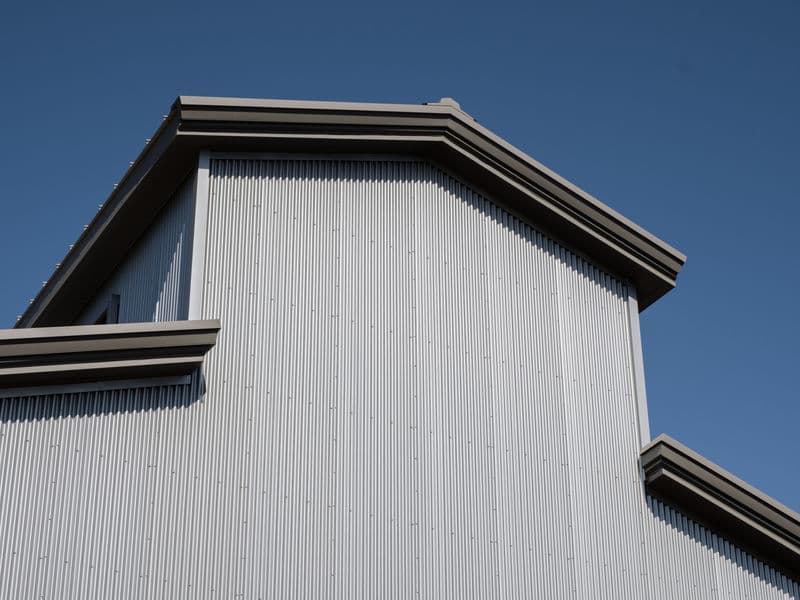
The result is a steel product with a coating that combines two types of corrosion protection. The aluminum creates a physical barrier between the steel and the environment. It is stable and does not oxidize easily, so it blocks moisture and oxygen from reaching the steel surface. The zinc provides galvanic protection, meaning it sacrificially corrodes at cut edges and scratches where the steel is exposed, protecting the bare steel underneath.
Think of it this way: the aluminum is the raincoat, and the zinc is the backup plan for when the raincoat gets a hole in it. That is what is galvalume and how it protects steel in one sentence.
What Does AZ55 Mean?
The “AZ” in AZ55 stands for aluminum-zinc. The “55” refers to the coating weight: 0.55 ounces per square foot, total both sides. This is the standard coating weight for exterior-grade Galvalume sheet used in steel building panels and roofing.
There is also AZ50, which has a coating weight of 0.50 ounces per square foot. AZ50 is sometimes used for interior panels or less demanding applications. The difference between AZ55 and AZ50 is about 10% in coating weight. For exterior use, AZ55 is what you want.
You might also see the designation expressed in metric: AZ55 is approximately 185 grams per square meter. Same coating, different units.
What Does The Galvalume Warranty Actually Cover?
The Galvalume warranty that matters is the perforation warranty. Most mills and panel manufacturers back galvalume AZ55 with a perforation warranty ranging from 25 to 40 years, depending on the product and the environment. That sounds impressive, but you need to understand what “perforation” actually means.
Perforation means the steel has rusted all the way through — there is a hole. It does not mean surface rust, staining, or cosmetic discoloration. If your panel develops an ugly rust streak but the steel is still intact, the warranty does not cover it. This is the single most common point of confusion for buyers. A 40-year perforation warranty is not a 40-year “looks like new” warranty.
Next, look at how the warranty pays out. Some warranties are full replacement for the entire term. Most are prorated, meaning the manufacturer pays a declining percentage of the panel cost as the years go by. A prorated warranty that pays 2% per year after year 20 is not worth much if the failure happens at year 30. Read the schedule.
Common exclusions void the warranty: improper installation (fasteners over-tightened, panels installed without proper sealant), chemical exposure (fertilizer, animal waste, industrial emissions), contact with dissimilar metals (copper, lead, certain treated woods), and standing water caused by poor drainage design. If the warranty document does not list these clearly, that is a red flag.
A good warranty document should specify the coating weight (AZ55), the substrate, the term in years, the payout schedule (full vs prorated), the exact exclusions, and the process for filing a claim. If the supplier hands you a one-page warranty that says “25 year warranty” and nothing else, you do not actually have a warranty — you have a marketing flyer. Ask us to see our warranty document. Call (888) 460-9294.
How Galvalume Compares To Other Coatings
Steel buildings use several types of corrosion protection. Here is how they stack up:
Galvalume (aluminum-zinc coating): The best overall corrosion protection for steel sheet. Service life in moderate environments can exceed 50 years. Performs well in a wide range of climates, including humid and coastal areas. The coating is applied at the steel mill before fabrication, so it covers the entire surface uniformly. Cut edges are protected by the zinc component.
Galvanized (zinc-only coating): The older technology. Pure zinc coating applied through hot-dipping. Galvanized steel has good corrosion protection, but it does not last as long as Galvalume in most environments. Galvanized coating typically provides 20 to 30 years of service life in moderate conditions. In coastal areas, galvanized steel may show rust in 10 to 15 years. The zinc coating is thicker than Galvalume but less effective per unit of thickness because it does not have the aluminum barrier.
Painted steel (without Galvalume substrate): Paint provides a barrier but no galvanic protection. If the paint is scratched, chipped, or degraded by UV exposure, the bare steel underneath is exposed and will rust. Painted steel without a metallic coating substrate is the cheapest option and the worst for long-term corrosion resistance. It is fine for indoor applications or short-term use, but not for a building you want to last decades.
Powder-coated steel: Similar to painted steel but with a thicker, more durable coating applied as a powder and then baked. Powder coating provides better abrasion resistance than wet paint, but it still lacks galvanic protection. Once the coating is damaged, the steel corrodes. Powder coating is more common on components like doors and trim than on large panels.
The key difference is this: Galvalume and galvanized coatings provide galvanic protection at cut edges and scratches. Paint and powder coating do not. A scratch on a painted panel exposes bare steel. A scratch on a Galvalume panel exposes steel that is still protected by the surrounding zinc in the coating.
Galvalume vs Galvanized: Which Is Better
Galvalume vs galvanized comes up constantly, and the answer is straightforward. Galvalume outperforms galvanized in almost every environment. The aluminum barrier in Galvalume slows corrosion more effectively than pure zinc, and the zinc component still protects cut edges. Galvanized is the older technology and is still used, but for a steel building you want to last decades, galvalume is the better steel panel coating.
The one exception: in environments with very high alkalinity (some agricultural and industrial settings), galvanized can occasionally outperform Galvalume. For 95% of buyers, that does not apply. When in doubt, ask us.
Why Galvalume matters in humid and coastal climates
Corrosion is not uniform. It depends on the environment, and the environment depends on where you live.
In dry climates with low humidity, even bare steel corrodes slowly. A painted panel might last 15 or 20 years before rust becomes a problem. But in humid climates, coastal areas, or places with industrial pollution, corrosion accelerates dramatically.
Moisture is the main driver. When humidity is high, a thin film of water forms on the steel surface. That water dissolves oxygen and any airborne salts or chemicals, creating an electrolyte that accelerates corrosion. The more moisture and the more contaminants, the faster the steel corrodes.
Coastal areas are the worst. Salt spray from the ocean deposits chloride ions on the steel surface, and chlorides are extremely aggressive in breaking down protective coatings. A painted panel in a coastal environment might start showing rust within 3 to 5 years. A galvanized panel might last 10 to 15 years. A Galvalume panel can last 30 to 40 years or more, even in coastal exposure — the kind our Connecticut and New Jersey state pages describe along their coastlines, and why coastal buyers there should treat Galvalume as the minimum coating, not an upgrade.
Galvalume’s aluminum barrier is what makes the difference in these environments. The aluminum oxide layer that forms on the surface is stable and self-healing. When it is damaged, it reforms quickly in the presence of oxygen, maintaining the barrier. The zinc provides backup galvanic protection, but in most environments, the aluminum barrier does most of the work.
How long does galvalume coating last? In a moderate climate, 40 to 50 years is realistic. In a coastal climate, 25 to 35 years before panel replacement. That is a wide gap, and it is why the coating matters more than almost any other spec on the building.
Galvalume On Solid-Frame Buildings
Solid-frame buildings benefit more from Galvalume than tube-frame buildings, and the reason comes down to geometry. A solid-frame building uses open cross-section components — I-beams, C-channels, Z-purlins — where both the inside and outside surfaces are exposed to air and can be coated at the mill. A tube-frame building uses hollow rectangular or square tubes. The inside of a tube is sealed and cannot be coated after welding, and pre-galvanized tube loses its coating at the weld seams during fabrication.
This matters because the worst corrosion is the corrosion you cannot see. On a solid-frame building, the secondary framing — purlins, girts, eave struts — is Galvalume-coated on every surface, including the surfaces that face the insulation and the interior. Condensation forms on those interior-facing surfaces every time the temperature swings. If they are bare steel, they rust from the inside out, hidden behind the insulation, and you do not find out until the panel starts showing a stain or the framing loses stiffness.
Galvalume on the secondary framing prevents this hidden corrosion problem. It is the difference between a building that lasts 40 years and a building that develops structural rust at year 15 in a humid climate.
If you are a residential buyer choosing between solid-frame and tube-frame, this is one of the strongest technical arguments for solid-frame. The coating actually covers the surfaces that need it. With tube-frame, you are trusting that the sealed interior of the tube stays dry forever, and that trust is often misplaced.
For the full buyer’s overview, see our Steel Building Buyer’s Guide.
The Cost Difference
Now that you know what is galvalume, the cost question is straightforward. Galvalume-coated steel costs more than painted steel. The premium is typically 10 to 15% on the panel cost, which translates to a modest single-digit percentage on the total building cost — small next to what it protects.
Is it worth it? Consider this: replacing the panels on a 40x60 building because they rusted through is a significant materials-and-labor expense, and that assumes the secondary framing is still in good condition. If the secondary framing also needs replacement because it was also bare steel, you are looking at a near-total rebuild.
The math is simple. Pay a few percent more up front for Galvalume, or pay a lot more later to replace corroded components. Most buyers who understand the choice choose Galvalume.
For more on how coatings affect building lifespan, see our article on How Long Steel Buildings Last.
How To Verify You Are Getting Galvalume
Here is the problem: some manufacturers say “coated steel” or “rust-proof panels” without specifying what the coating is. You need to ask specifically.
The question to ask is: “Are the panels Galvalume AZ55-coated, and is the coating applied at the steel mill before fabrication?” The answer should be yes. If the answer is “painted” or “powder-coated” or “galvanized,” you are getting a different product. If the answer is vague, ask for the panel specification sheet. It should list the substrate, the coating type, and the coating weight.
Also ask about the secondary framing. As we discussed in our article on Steel Building Quality, some manufacturers use Galvalume on the panels but bare or painted steel on the secondary framing. The secondary framing is inside the building, exposed to condensation and humidity. If it is not Galvalume-coated, it will corrode, even if the panels do not.
What About The Paint On Top Of Galvalume?
Galvalume-coated panels are usually painted with a silicone-modified polyester or Valspar coating. The paint provides color and UV protection. The Galvalume underneath provides corrosion protection.
This is the best of both worlds. You get the color and appearance you want, and you get the corrosion protection you need. The paint warranty covers fading and chalking. The Galvalume perforation warranty covers perforation due to corrosion. They are separate warranties for separate issues.
The paint system matters too. Silicone-modified polyester (SMP) is the standard paint system. It has good color retention and chalk resistance for 20 to 25 years. Valspar paint baked on is the premium paint system. It has superior color retention, chalk resistance, and UV stability, with warranties up to 40 years. Valspar costs more, but if you want the building to look good for decades in a sunny climate, it is worth considering.
The Bottom Line
Galvalume AZ55 is the best corrosion protection available for steel building panels and roofing. It outlasts galvanized coating, painted steel, and powder coating by a wide margin, especially in humid and coastal environments. The cost premium is small compared to the cost of replacing corroded panels or secondary framing.
If you are buying a steel building, make sure the panels are Galvalume AZ55. Make sure the secondary framing is also Galvalume-coated. And make sure you get the perforation warranty in writing.
If your supplier cannot confirm these things, or if they tell you that painted steel is “just as good,” you are talking to the wrong supplier. Call us at (888) 460-9294 or email estimating@northcraftsteel.com and we will walk you through it.