
If you’re weighing a pole barn against a steel building, you’re asking the right question at the right time. A few years ago, the pole barn was almost always the cheaper way in the door. That gap has been closing, and in a lot of markets it’s gone. Both buildings do their job. They just don’t do it for the same number of years, in the same conditions, or with the same maintenance bill.
We sell solid-frame steel buildings — C-channel and I-beam — so we have a stake in this comparison. We’ll still tell you plainly where a pole barn is the right choice. A customer sold the wrong building for their situation isn’t a customer we keep.
What a Pole Barn Actually Is
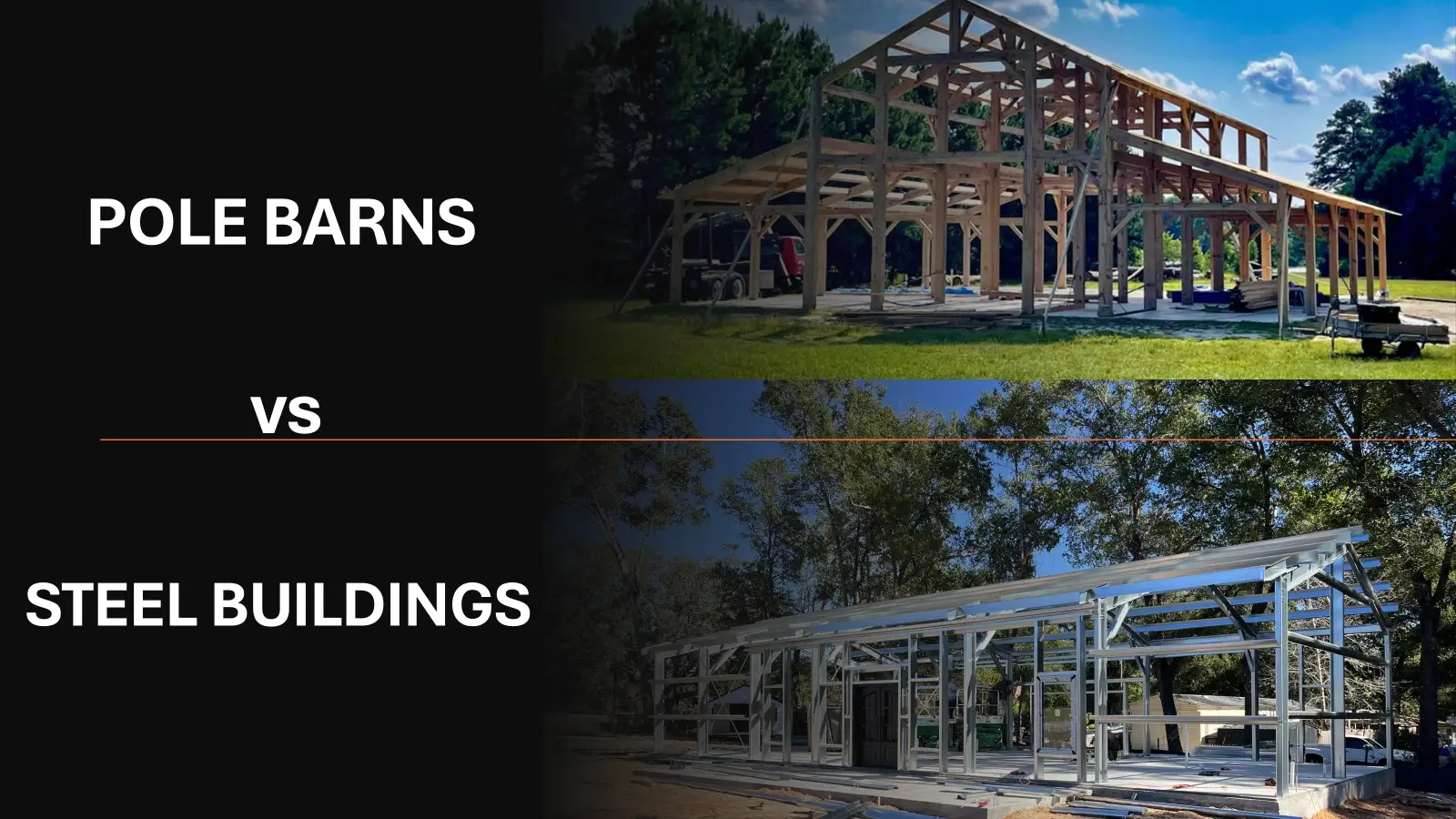
A pole barn, also called a post-frame building, is framed with wood posts, usually pressure-treated, set into the ground or anchored in concrete piers. The posts carry the roof trusses and wall girts directly — there’s no separate foundation wall doing the structural work. Pole barns have been the default for agricultural buildings, storage, and horse arenas for decades because the method is simple and the materials are ordinary lumber-yard stock.
What We Mean by “Steel Building”
When we say steel building, we mean a solid-frame structure: heavy structural steel, C-channel or I-beam, bolted together at engineered connections, with steel girts and purlins carrying the wall and roof panels. C-channel is the more affordable frame, suited to residential and light-commercial projects. I-beam is the heavier frame used for wider spans and commercial or industrial work — we cover that split in more detail in I-Beam vs. C-Channel vs. Tube Steel.
On both frames, the girts and purlins are coated in Galvalume AZ55. That’s not paint — it’s a molten aluminum-zinc bath the flat steel passes through before it’s roll-formed, and the coating bonds to the surface metallurgically. It’s the reason the secondary framing doesn’t rust from the inside out the way an untreated frame would. (For what that coating actually does, see What Is Galvalume AZ55?.)
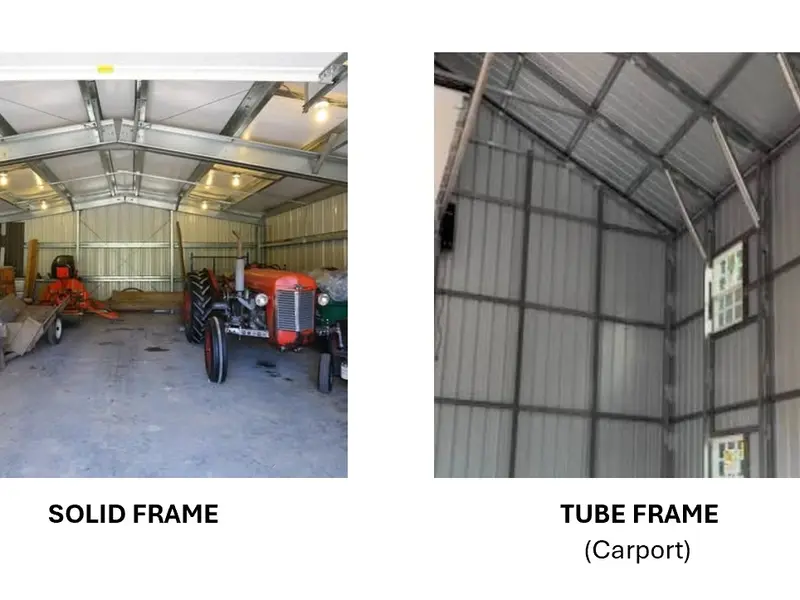
One more distinction worth making: this comparison is about solid-frame steel buildings, not tube-steel carports. A carport is a lighter, cheaper product with a different price point and a different lifespan. If that’s what you’re actually comparing to a pole barn, the math here doesn’t apply.
Cost: Why the Old Assumption Doesn’t Hold
For years, “steel costs more upfront” was true. It isn’t reliably true anymore, and this is the part of the comparison most advice online hasn’t caught up to.
A pole barn is stick-built on site, board by board, which means its price is driven almost entirely by two things: lumber and skilled labor. Both have gotten more expensive and more volatile over the last several years. A steel building arrives with the engineering and fabrication already done — what’s left on site is assembly, not construction from raw materials. That moves a lot of the cost risk off your project and onto a factory floor, where it’s more predictable.
We’re not going to hand you a number here, because the honest number depends on your size, your site, and your local labor market. Get both quoted for your project and compare real, current numbers — not the ones from an article written five years ago. See our full cost breakdown for what actually drives a steel building’s price. What we will say is this: assuming the pole barn is automatically cheaper is the single most out-of-date idea in this comparison, and it’s the one costing people the most money when they skip the second quote.
Durability and Lifespan
This is where the two options really separate.
A well-built, well-maintained pole barn typically lasts 30 to 40 years. Pressure-treated wood resists rot for a long time, but it’s still wood — it absorbs moisture, and the posts at or below grade are the weak point no treatment fully solves. Eventually, ground contact wins.
A properly engineered steel building, with Galvalume AZ55 girts and purlins and normal maintenance, commonly lasts 40 to 50 years, and 50 to 60 in dry climates. Steel doesn’t rot, warp, or feed insects. The parts that wear out are the same on any building: seals, gaskets, weatherstripping — all replaceable without touching the frame. See our full lifespan breakdown by climate for the specifics.
The gap usually becomes obvious around year 15 to 20. That’s when a pole barn starts needing post repair or replacement, and a steel building built correctly is still asking for very little.
Fire Resistance
Wood burns. Steel doesn’t. That’s the whole fact, and it matters more than people think until they’ve had a close call.
A pole barn’s wood framing adds fuel to any fire that starts inside — an electrical fault, a heater malfunction, a lightning strike. Steel framing doesn’t feed a fire the same way. It will deform under enough heat, but it doesn’t contribute fuel, which is often the difference between a contained fire and a total loss. If you’re storing equipment, vehicles, or livestock, this isn’t a minor line item. Fire-risk classification affects how insurers price wood-frame agricultural buildings — ask your agent for real numbers on both structures before you decide.
Maintenance Over Time
Both buildings need upkeep. The type and frequency aren’t close.
Pole barn maintenance means watching for post rot at ground level, treating exposed wood, repainting or replacing panels that rust, and dealing with doors and windows that shift as the wood frame moves with moisture. A steel frame doesn’t move that way — the connections are bolted and rigid, so a door that fits well in year one should still fit in year fifteen. Steel building maintenance is mostly inspection: fasteners, sealants, gutters, panel coating. There’s less to go wrong, and what does go wrong is usually cheap to fix.
Foundations, Permits, and Code
Pole barns are popular partly because they skip a full concrete foundation — the posts themselves do that job. Steel buildings typically go on a slab or footings, which is a real added step and a real reason some buyers lean toward a pole barn on smaller, lower-stakes projects. Foundation and erection are priced separately from the building itself, and if you want help arranging that concrete work or the crew to erect the building, that’s something we can help set up — ask your estimator when you get your quote.
Both building types need a permit almost everywhere, and both need real engineering behind them, not only for the building department but so the structure holds up under your actual local snow and wind. Steel buildings come with stamped engineering drawings as standard, calculated for your specific site. Not every pole barn package includes that. Confirm it before you sign anything — an unengineered building can still get you a permit and still be under-built for your area.
When a Pole Barn Is the Right Call
We’ll say it straight: a pole barn is a reasonable choice for unheated agricultural storage, mild-climate horse arenas and livestock shelters, low-fire-risk equipment storage, and anything you genuinely expect to use for 20 years or less. If that’s your project, don’t let anyone talk you out of it on price alone. Get a steel quote too, so you’re choosing the pole barn because it actually fits, not because you assumed it was cheaper.
When a Steel Building Is the Right Call
Lean steel if you need a wide clear span, a conditioned space (workshop, commercial unit, barndominium), a high wind or snow zone, real fire resistance for valuable contents, or decades of service with low maintenance.
The Bottom Line
Pole barns and steel buildings serve different jobs, not different tiers of the same job. If you need something inexpensive for light agricultural use and you’re not planning to own it for decades, a pole barn can be the right answer — we’ll tell you that on the phone. If you want a building that holds up for decades with real fire resistance and minimal upkeep, steel is the better investment, and increasingly, the cost gap that used to justify wood isn’t there to begin with.
Talk it through with us before you commit. Read our Steel Building Buyer’s Guide, call (888) 460-9294, or email estimating@northcraftsteel.com. We’ll give you a straight answer, even when that answer is “get the pole barn.”
FAQ
Is a pole barn actually cheaper than a steel building?
Not as reliably as it used to be. Pole barn pricing is driven by lumber and site labor, both of which have risen and stay volatile. A steel building's engineering and fabrication happen in a shop, which shifts a lot of that cost risk off your project. Get both quoted before you assume — the real comparison depends on your size, site, and market.
How much longer does a steel building last than a pole barn?
A well-built pole barn typically lasts 30 to 40 years, mainly limited by the wood posts at ground level. A properly engineered, Galvalume-coated steel building with normal maintenance commonly lasts 40 to 50 years, and 50 to 60 in dry climates. See our full lifespan breakdown.
Do pole barns need a concrete foundation?
Usually not a full foundation. The wood posts, set into the ground or concrete piers, carry the structural load directly. Steel buildings typically need a slab or footings, which is a real cost and step a pole barn skips.
Are pole barns a fire risk?
Wood-frame construction is combustible in a way steel isn't. That doesn't make a pole barn unsafe, but it's a real factor in how a fire spreads, and often in your insurance premium, especially if you're storing equipment or vehicles inside.
Can I get a wide clear span with a pole barn?
Yes, with trusses, but wide spans get truss-heavy and expensive fast, and you lose interior height compared to a clear-span steel frame. If you need serious open floor space, steel is usually the more efficient way to get it.
Does Northcraft sell C-channel or I-beam buildings?
Both. C-channel is the more affordable solid frame for residential and light-commercial projects. I-beam is the heavier frame for wider spans and commercial or industrial use. Both come with stamped engineering drawings, and both use Galvalume AZ55 girts and purlins.