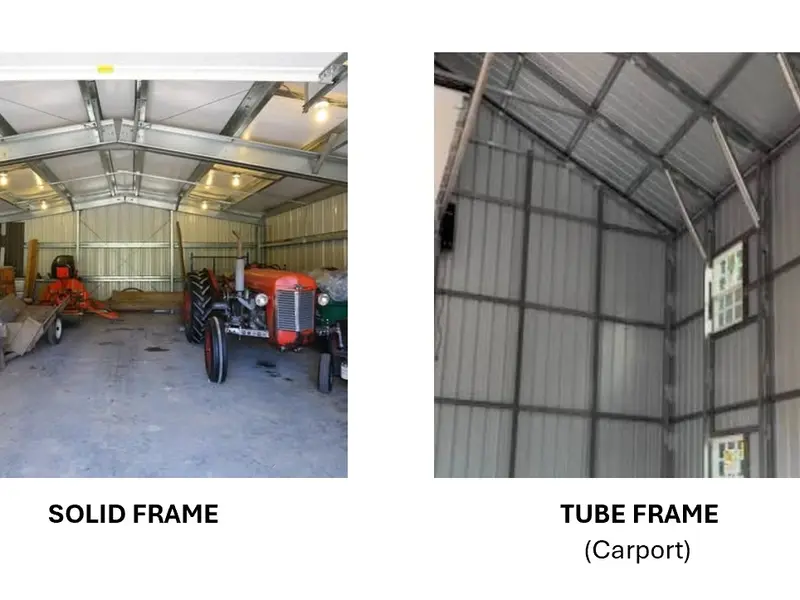

“Red iron” is trade slang for heavy, hot-rolled or welded-plate structural steel — the name comes from the red oxide primer many mills apply at the shop. It is the material behind Northcraft’s I-beam line. The other two framing options split a different way: solid, cold-formed C-channel, and hollow tube steel. Only one of those three is a hollow cross-section; the other two are solid steel, just at different thicknesses and price points.
Northcraft’s I-beam main frames are hot-dip galvanized and finished with a gray painted primer, not red, and every girt and purlin is coated in Galvalume AZ55 — so “red iron” describes the kind of steel, not the color you will see.
Buyers often ask us “do I need red iron?” expecting a yes-or-no answer, but the real question is which of three real options fits your project: I-beam, C-channel, or tube steel. Here is how to actually decide.
The three options, side by side
I-beam. Heavy hot-rolled (W-shape) or welded-plate structural steel, bolted together at rigid frame connections. This is Northcraft’s I-beam line, published on a 12-foot eave-height basis. It is solid-frame construction — the steel cross-section is a continuous solid shape, not hollow.
C-channel. Cold-formed solid structural steel — a continuous cross-section, not hollow, structurally bolted together the same as I-beam. This is Northcraft’s residential and light-commercial line, published on a 10-foot eave-height basis, and it is specified as thick as 10-gauge steel where the load calls for it — often heavier than the 14-16-gauge tube steel most “light-duty” competitors sell as their heavier option.
Tube steel. Cold-formed hollow square or rectangular tubing, typically 14-16 gauge, connected with brackets and screws rather than structural bolts. This is hollow-frame construction — the defining structural difference from both I-beam and C-channel, which are both solid. We cover the solid-vs-hollow structural differences (corrosion, connection strength, clear span, lifespan) in full in our solid frame vs. tube frame article, and we will not repeat that comparison here — this article is about choosing between the two solid-frame options, and where tube fits relative to both.
Why gauge number is not the same as strength
Here is where buyers get confused: a bigger gauge number sounds like it should mean a bigger, stronger building, but gauge works backwards — a lower number is thicker steel. Northcraft’s C-channel is specified as thick as 10-gauge, while most tube steel tops out around 14-16 gauge, so a “10-gauge” building is the heavier-duty one even though 10 is the smaller number. Cross-section shape (solid vs. hollow) and steel thickness (gauge) are two separate specs, and neither one is a synonym for the other. A C-channel garage at a real structural gauge is a real, durable, solid-frame building — it is simply a lighter-duty solid-frame product than a heavy I-beam commercial building needs to be, not a hollow one.
When you need an I-beam frame
You are likely in I-beam territory if:
You need a clear span beyond what C-channel can reasonably cover — large commercial or industrial buildings, wide warehouse floors
Your building carries real collateral load — a crane, a heavy mezzanine, a sprinkler system. Collateral load is one of Northcraft’s five what-moves-the-price factors, and it applies specifically to I-beam buildings, not C-channel
You are building at commercial or industrial scale where the extra structural capacity is genuinely load-bearing, not just reassuring
If any of those apply, the fabrication quality of the I-beam itself — steel grade, weld quality, connection design — becomes the thing worth scrutinizing next. Our I-beam quality article covers exactly what separates a well-fabricated I-beam building from a cheap one.
When C-channel is the right call
You are likely well served by C-channel if:
You are building a residential garage or workshop, or a barndominium
Your building does not carry real collateral load — no crane, no heavy fixed equipment, no sprinkler system to support
Your clear-span needs fit within what solid-frame C-channel construction covers, which is a wide range for residential and light-commercial use
This is the sweet spot for most of the buyers we talk to: solid-frame durability and performance, at a lower cost than I-beam, because the loads a C-channel building is designed for genuinely do not need I-beam’s extra capacity.
When tube steel is genuinely enough
Tube steel has a real place, covered in detail in our solid-vs-tube article: a carport, a small storage shed, a basic livestock shelter in a mild climate, or any structure where a shorter service life and lighter-duty performance are an honest tradeoff for a lower price. It is not a substitute for C-channel or I-beam when you need real wind and snow performance, a wide clear span, or a 40-plus-year service life — but for the right use case, it does the job for real money saved.
What actually drives the decision
In practice, the choice usually comes down to three questions: how wide a clear span do you need, does your building carry collateral load, and how long do you need it to last. Wide span or real collateral load points toward an I-beam frame. A standard residential or light-commercial footprint with no unusual loads points toward C-channel. A short-service-life, budget-first project is where tube steel is an honest choice, not a compromise. For help thinking through the size and use side of that decision, see our article on what size steel building you need.
Tell us what you are building
If you are not sure which of these three fits your project, tell us your clear span, what the building needs to carry, and how long you want it to last, and we will tell you honestly which frame type makes sense — including if that answer is tube, not one of our own solid-frame lines. Call (888) 460-9294 or email estimating@northcraftsteel.com.