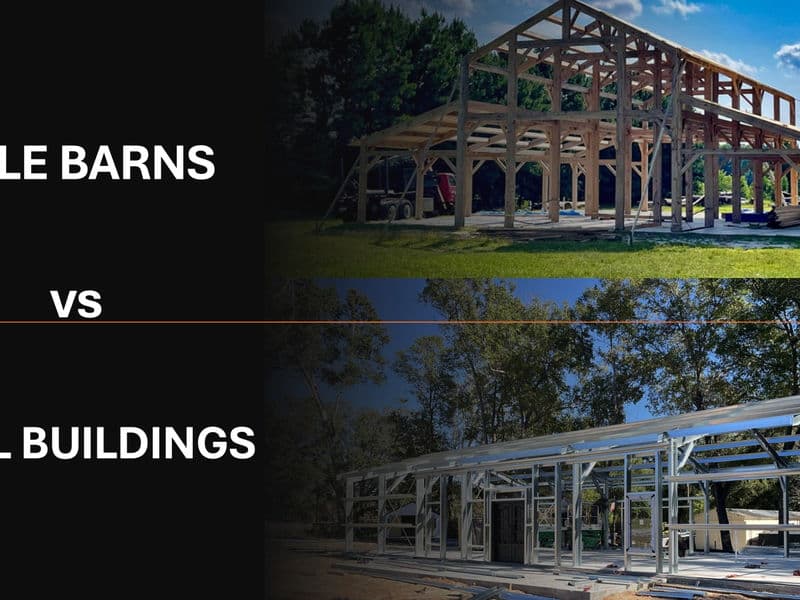

Wood framing used to have a clear, reliable price advantage over steel. That advantage has narrowed sharply, and in a lot of markets it has closed entirely — lumber and skilled framing labor have both gotten more expensive and more volatile over the past several years, while steel building fabrication has stayed a predictable, factory-priced process. This is not a claim specific to pole barns; it applies to any wood-framed structure, from traditional stick-built framing to post-frame construction.
We cover the pole-barn-specific comparison — cost trends, lifespan, fire risk and maintenance — in our pole barn vs. steel building article. This one is the broader case: why wood framing generally, not just post-frame specifically, has lost most of its historical cost edge, and where it still makes sense.
Why the upfront cost gap has narrowed
Wood construction cost is driven by two things: the price of lumber itself, and the cost of the skilled labor to frame it on site, board by board. Both have moved against wood’s traditional cost advantage. Lumber prices have been meaningfully more volatile over the past several years than in the decades before, with periods of sharp spikes that made wood framing unpredictable to bid and budget. Skilled framing labor has also gotten more expensive and, in a lot of markets, harder to find on the timeline a project needs.
A steel building, by contrast, is fabricated in a plant to an engineered spec and arrives as a defined package — the price you are quoted is not exposed to the same day-to-day material and labor volatility a stick-built project is. For our own current published floor prices by size, see how much a steel building costs.
Traditional stick-frame vs. steel
Traditional 2x-lumber stick framing — the construction method used in most houses and many outbuildings — carries the same on-site labor dependency as post-frame construction, plus additional complexity: more individual framing members, more connections, and typically a full continuous foundation rather than the point-load footings a pole barn can sometimes use. That complexity generally makes stick-frame construction more labor-intensive, not less, than post-frame — which means the labor-cost pressure closing wood’s price advantage applies at least as strongly here.
Stick-frame construction also faces the same structural ceiling relative to steel: wider clear spans require larger engineered lumber or additional support columns, wind and snow engineering depends on species and grade in ways that can require oversized members in demanding climates — the elevation-driven snow load documented on our Utah and Idaho state pages is a good example of how far that swing can go — and the assembled structure is combustible in a way solid-frame steel is not.
What steel costs that wood does not, and vice versa
To be fair to wood: a stick-frame or post-frame building can sometimes go up with less specialized equipment and a broader pool of available local labor than an engineered steel erection crew, which matters in some rural markets. Wood is also, for some buyers, simply the more familiar material to finish and modify later using standard carpentry tools and skills.
Steel costs more to fabricate per pound of raw material, but that cost buys engineering precision, a defined delivered price with less exposure to material-cost swings mid-project, and a structural system that does not carry wood’s long-term maintenance and lifespan disadvantages — see our maintenance article for what that upkeep gap actually looks like in practice over time.
The cost comparison that actually matters
Comparing wood and steel on upfront price alone is the comparison that made sense a decade ago and often does not anymore. The comparison worth making is total cost of ownership: upfront price, plus maintenance, plus insurance (wood-frame structures typically cost more to insure due to fire risk), plus how long the structure actually lasts before it needs major repair or replacement. Our pole-barn article walks through that full math for post-frame construction specifically — the same logic extends to stick-frame construction, generally with an even smaller upfront cost gap given the additional labor complexity involved.
When wood still makes sense
We are not going to tell you wood framing is obsolete — it is not, and being honest about that is the whole point of this article. Wood remains a reasonable choice when:
The structure is genuinely temporary, with a planned service life of well under 20 years
Local skilled wood-framing labor is unusually available and affordably priced in your specific market
You are adding onto or matching an existing wood structure where mixing materials creates its own complications
The building will never be insulated, conditioned, or asked to carry real structural loads beyond basic shelter
If none of those describe your project, and especially if you plan to own the building for more than 15 years or ever condition the space, the numbers increasingly favor steel — not because wood got worse, but because the old price advantage that used to make wood the obvious default has genuinely eroded.
Get real numbers for your project
The right way to make this decision is to get both quoted for your actual project, not to rely on outdated assumptions about which one is cheaper. Call us at (888) 460-9294 or email estimating@northcraftsteel.com for a real number on the steel side, and compare it against a real local wood-framing bid — not a number either of us remembers from a few years ago.