

If you are comparing steel building quotes and one is $15,000 and the other is $20,000, the cheaper one looks like the better deal. But what if the $15,000 building has 2,000 pounds of steel in it and the $20,000 building has 10,000 pounds? One costs $7.50 per pound. The other costs $2.00 per pound. The cheaper building is not cheaper at all. You are just buying a lot less steel.
Steel building price per pound is the single most revealing number in a quote, and almost nobody talks about it. Most buyers compare total price and pick the lowest one. That is exactly what some suppliers count on. If you want to know what you are actually paying for, call us at (888) 460-9294 and we will walk you through it.
Why Steel Building Weight Matters More Than Total Price
When you buy a steel building, you are buying steel. The framing, the panels, the secondary framing, the bracing. It is all steel. The amount of steel in a building is what determines its structural capacity, its wind rating, its snow load, and how long it will last.
A building with 10,000 pounds of steel and a building with 2,000 pounds of steel are not the same product. They are not engineered for the same loads. They will not perform the same in a storm. They will not last the same number of years. But if you only look at the total price, you might think you are comparing two versions of the same thing. You are not.
This is why knowing the steel building weight is so important. Two quotes for a 30x40 building can have wildly different amounts of steel inside them. The heavier building has more framing, thicker members, more bracing, and probably higher engineering specs. The lighter building has less of all of that. The price difference reflects the amount of steel and the quality of the engineering, not just the manufacturer’s markup.
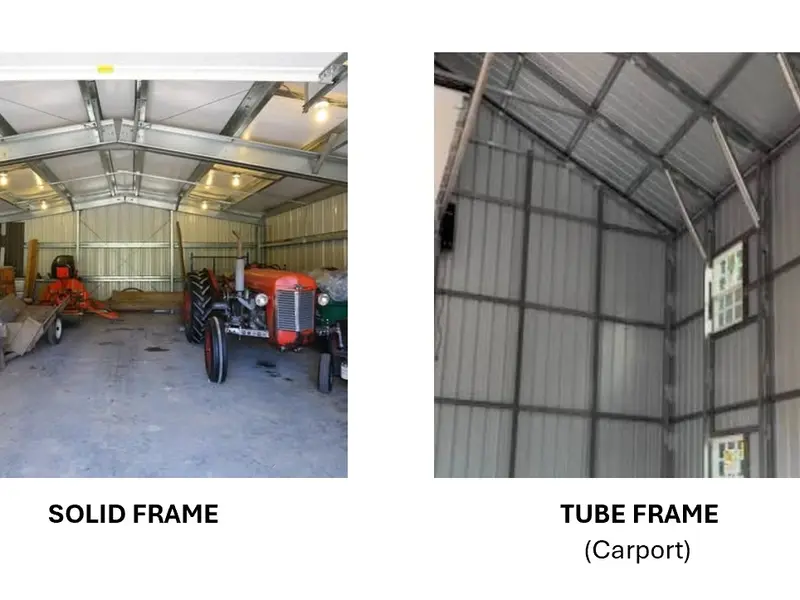
We explain the different framing types in our Solid Frame vs. Tube Frame article, but the short version is that tube-frame buildings use a fraction of the steel that solid-frame buildings — C-channel or I-beam — do. If you want the full buyer’s overview, our Steel Building Buyer’s Guide covers all three types.
How To Calculate Steel Building Price Per Pound
The formula is simple:
Price per pound = Total building price / Total steel weight
That is it. Take the total quoted price of the building (not including foundation or installation) and divide it by the total weight of the structural steel in it.
Here is the example that catches most buyers off guard:
| Building | Total price | Steel weight | Price per pound |
|---|---|---|---|
| Building A (tube-frame) | $15,000 | 2,000 lbs | $7.50/lb |
| Building B (C-channel) | $20,000 | 10,000 lbs | $2.00/lb |
| Building C (I-beam) | $30,400 | 16,000 lbs | $1.90/lb |
Building A is the cheapest by total price. But it costs nearly four times as much per pound of steel as Building B. The buyer who picks Building A thinks they saved $5,000. What they actually did was buy 8,000 fewer pounds of steel.
Building C, the I-beam, costs the most in total but has the lowest price per pound. It also has the most steel and the highest engineering capacity. For a commercial buyer, it might be the right choice. For a residential buyer, Building B is the sweet spot. For a more detailed breakdown of pricing by frame type, see our Steel Building Cost article.
Why Cheaper Steel Buildings Cost More Per Pound
The reason cheaper buildings cost more per pound is that you are buying less steel. A tube-frame building uses thin-walled hollow tubing. The total weight of steel in a 30x40 tube-frame building might be 1,500 to 2,500 pounds. A C-channel building of the same size might weigh 8,000 to 12,000 pounds. An I-beam building might weigh 12,000 to 20,000 pounds.
The tube-frame building is cheaper to manufacture because there is less steel in it. The material cost is lower. The shipping cost is lower. The engineering is simpler. But the manufacturer’s margin per pound of steel is actually higher, because they are selling less steel for more money per pound.
This is why cheaper steel buildings cost more per pound than heavier buildings. You are paying a premium for less material. The manufacturer saves on steel and passes a fraction of the savings to you, keeping the rest as margin. You think you got a deal. They sold you 2,000 pounds of steel for $15,000.
What Does A Steel Building Weigh?
The weight of a steel building depends on the framing type, the size, the gauge of the secondary framing, and the engineering specs. Here are some rough ranges for a 30x40 building:
A tube-frame building: 1,500 to 2,500 pounds. Thin-walled hollow tubing, minimal secondary framing, lighter panels.
A C-channel building: 8,000 to 12,000 pounds. Cold-formed steel sections, heavier gauge primary & secondary framing, more bracing, Galvalume-coated panels.
An I-beam building: 12,000 to 20,000 pounds. Heavy structural I-beams, heavy secondary framing, heavy panels, more connection hardware.
The weight difference between a tube-frame and a solid-frame building of the same size can be 4 to 5 times. That is not a subtle difference. It is the difference between a building that can handle 90 mph wind and one that can handle 130 mph. It is the difference between a building that lasts 10 to 15 years and one that lasts 40 to 50. For more on that, our article on How Long Steel Buildings Last breaks it down by framing type.
How to ask your supplier for steel weight
This is where most buyers get stuck. They do not know how to find out the weight of the building they are being quoted. Here is what to do.
Call the supplier and ask: “What is the approximate total weight of the steel in this building?” If they cannot answer, or say they do not know, that is a red flag. Any manufacturer who fabricates steel buildings knows how much steel goes into their product. They ship it on a truck. They have freight weight tickets.
If they give you a number, write it down. Then divide the total building price by that number. That gives you your price per pound. Do this for every quote you get. For a full list of questions to ask, our 25 Questions article has you covered.
If a supplier will not give you the weight, ask why. There is no legitimate reason to keep the weight of a steel building secret. The only reason to hide it is that the weight would reveal how little steel is actually in the building.
Buyer Checklist: Using Price Per Pound To Compare Quotes
Here is a practical step-by-step process for using price per pound when you shop:
1. Get the total building price from each supplier (not including foundation or installation).
2. Ask each supplier for the approximate total weight of structural steel in the building. Get it in writing.
3. Divide price by weight to get price per pound for each quote.
4. Compare buildings with similar framing types. Do not compare a tube-frame price per pound to an I-beam price per pound. They are different products. Compare tube-frame to tube-frame, C-channel to C-channel, I-beam to I-beam.
5. If one quote has a dramatically different price per pound than the others, find out why. It might be a different steel grade, a different coating, a different warranty, or different included features.
6. Ask about the engineering specs: wind load, snow load, exposure category. Buildings with higher ratings have more steel and should weigh more.
7. Factor in what is included. A higher total price with doors, windows, and insulation included might be a better deal than a lower price with nothing included.
8. Use price per pound as one tool, not the only tool. Combine it with engineering specs, coating quality, warranty terms, and included features to make your decision.
FAQ: Steel Building Price Per Pound
How do you calculate steel building price per pound?
Divide the total building price by the total weight of structural steel in pounds. For example, a $15,000 building weighing 2,000 lbs costs $7.50 per pound. A $20,000 building weighing 10,000 lbs costs $2.00 per pound. The formula is: price per pound = total price / steel weight.
Why is a cheaper steel building sometimes more expensive per pound?
A cheaper building often contains less steel. A tube-frame building might have 2,000 pounds of steel while a C-channel building of the same size has 10,000 pounds. The tube-frame building costs less in total but more per pound because you are buying a fraction of the steel. The lower total price reflects less material, not a better deal.
What does a steel building weigh?
It depends on the framing type. A 30x40 tube-frame building might weigh 1,500 to 2,500 pounds. A 30x40 C-channel building might weigh 8,000 to 12,000 pounds. I-beam framing weighs more still — Northcraft's own I-beam sizing starts at 50x50, where a building might weigh 12,000 to 20,000 pounds or more. Both C-channel and I-beam are solid-frame — the weight difference between framing types can be 4 to 5 times.
Should I only compare steel buildings by price per pound?
No. Price per pound is a useful tool but it does not tell the whole story. Two buildings with the same price per pound can differ in steel grade, design loads, corrosion protection, connections, warranty, and included features. Use price per pound alongside engineering specs, coating quality, and warranty terms to make your decision.
How do I find out the weight of a steel building I'm being quoted?
Ask the supplier directly: “What is the approximate total weight of the structural steel in this building?” Any manufacturer knows how much steel goes into their buildings. They ship them on trucks with freight weight tickets. If a supplier will not give you the weight, ask why. There is no legitimate reason to keep it secret.
The Bottom Line
Steel building price per pound is the number that tells you what you are actually buying. Total price hides the difference between a building with 2,000 pounds of steel and one with 10,000. Price per pound reveals it.
The next time you compare quotes, ask for the weight. Do the division. If the cheapest quote has the highest price per pound, you are not saving money. You are buying less steel and paying more for each pound of it.
If you want help running the numbers on quotes you already have, call us at (888) 460-9294 or email estimating@northcraftsteel.com. We will do the math with you, no strings attached. And if a cheaper building makes sense for your situation, we will say so. That is the only way we know how to do business.