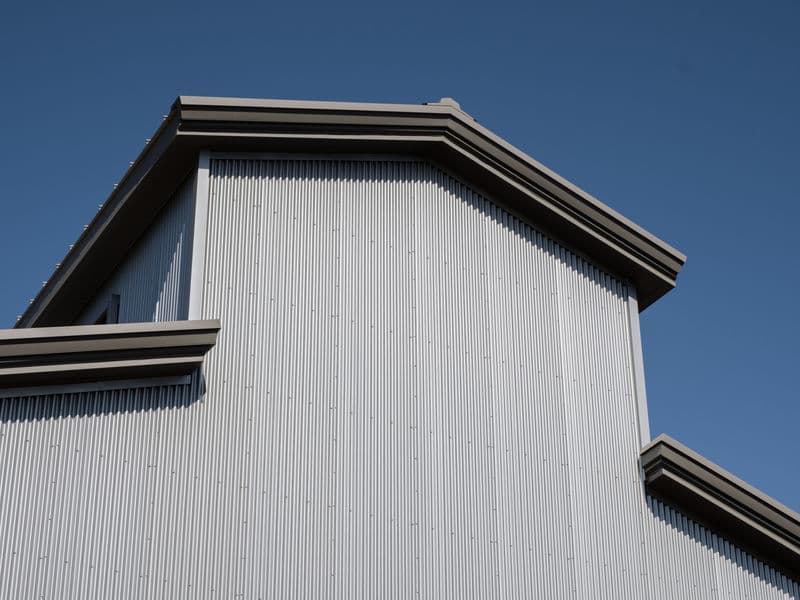

Trim is the least glamorous line item on a steel building quote, and the easiest one for a supplier to quietly drop to hit a lower price. It’s also the piece that determines whether every seam, corner, and opening on the building actually sheds water the way the rest of the design assumes it will. A building can have the right frame, the right coating, and the right hardware, and still leak at the eave because nobody closed the gap trim exists to close.
Every Northcraft building ships with a full trim package included, standard, on every frame type. Here’s what that trim actually does, and what happens on a building that skips it.
What “Trim” Actually Covers
Trim isn’t one part — it’s a family of formed metal pieces that close the gaps a flat roof or wall panel can’t close on its own: eave trim along the roofline, gable trim at the roof’s end walls, corner trim where two wall planes meet, base trim where the wall meets the foundation, and trim around every door and window opening. Panels are engineered to shed water across a flat, uninterrupted surface. Every corner, edge, and penetration is a place that surface breaks, and trim is the piece that carries water past that break instead of letting it find a way in.
What Happens Without It, Over Time
A building missing trim, or built with an undersized or poorly-fitted trim package, doesn’t fail on day one. It fails at the seams, gradually, in ways that are easy to miss until the damage is already done.
Water intrusion at panel laps and edges. Where two panels overlap, or where a panel edge meets a corner, an unsealed gap lets wind-driven rain track behind the panel instead of running off the surface. That water doesn’t stop at the edge — it travels along the inside of the panel or down a purlin, the same way a failed fastener washer lets water travel before it shows up as a stain (see our article on steel building hardware for the same pattern from a different cause).
Corrosion that starts exactly where trim is designed to stop it. An unsealed edge is bare or exposed metal sitting in standing moisture longer than the rest of the panel surface, which is exactly the condition that accelerates corrosion in humid or coastal climates — the same climate risk our article on Galvalume AZ55 covers in more detail. Trim doesn’t just look finished. It keeps water moving instead of pooling at the one place on the building most likely to start rusting first.
Pest and rodent entry points. A gap at the base of the wall, or an unsealed opening around a door or window, is also an entry point for anything smaller than the gap itself. Base trim in particular closes the space between the wall panel and the foundation — skip it, and that gap sits open at ground level for the life of the building.
A less finished building, full stop. Beyond the functional failures above, a building without proper trim simply looks unfinished — raw panel edges, visible fasteners, gaps at every corner. That’s a real, practical cost too: it’s the difference between looking like an engineered structure and looking like an assembly of sheet metal.
Why Some Suppliers Sell It Separately
Trim is easy to under-quote because it’s easy to under-scope: a supplier can price “roof and wall panels” without specifying how much trim comes with them, and a buyer comparing two quotes by the headline number won’t necessarily notice the gap until the building shows up without enough trim to finish the corners. It’s a way a lower quote can turn into a higher final cost — see our guide on how to compare steel building quotes like an expert for the other line items worth checking the same way.
Northcraft doesn’t sell trim as an upsell. A full trim package is included on every building we build, regardless of frame type, because the alternative is selling a building that can’t do the one thing the panels themselves are relying on it to do.
What To Ask a Supplier
Ask directly: is a full trim package included in this quote, or is trim priced separately? If it’s separate, ask exactly which pieces are included at the quoted price — eave, gable, corner, base, and opening trim are not interchangeable, and a quote that includes some but not all of them is not a complete trim package. The same discipline applies here as with hardware and coating: ask for the specifics, not the summary (see our guide on questions to ask a steel building supplier before you sign).
Why Trim Matters More in Snow, Wind, and Coastal Climates
A gap trim would have closed doesn’t just sit there quietly in a mild climate — it’s put under active pressure by weather. Wind-driven rain during a hurricane-force storm finds an unsealed seam far more aggressively than ordinary rainfall does. Sliding and melting snow at the eave puts real, repeated water load exactly where eave trim is designed to manage it. And the same humid or coastal conditions that accelerate panel corrosion (covered in our Galvalume AZ55 article) accelerate corrosion at an unsealed edge even faster, because standing moisture has a direct path to bare or exposed metal right at the seam.
That’s the same reasoning behind sizing a building for real, engineered snow load and wind exposure rather than a generic minimum: the building’s weakest detail is the one under the most stress in the conditions it’s actually built for. A full trim package matters everywhere. It matters more in the climates Northcraft’s markets are chosen for in the first place.
Frequently Asked Questions
What exactly is included in a “full trim package”?
Eave trim, gable trim, corner trim, base trim, and trim around every door and window opening — the complete set needed to close every seam and edge on the building, not a partial selection of pieces.
Does trim package scope change with frame type or building size?
A full trim package is included standard on every Northcraft building regardless of frame type. Ask us about your specific project for exact scope on a larger or more complex building.
Can I add extra trim later if I skip some now to save money?
Not with Northcraft — the full trim package is included standard on every building we build, so there’s nothing to skip in the first place. If you’re weighing that trade-off on a quote from another supplier: retrofitting trim onto an already-erected building is more expensive and more disruptive than including it at build time, and the building is exposed to the failure modes above for as long as the gap exists.
Is base trim really necessary if the building sits on a solid concrete slab?
Yes. Base trim closes the gap between the wall panel and the foundation regardless of foundation type — it’s addressing the panel-to-foundation seam, not the foundation material itself.
Why do some suppliers price trim separately instead of including it?
It lets the headline number on a quote look lower while shifting a real cost to a separate line item a buyer may not think to compare — see our guide on comparing quotes for the other places this happens.