
Steel buildings come with four real insulation options — fiberglass batt, rigid foam board, spray foam, and reflective barrier — and the right one depends almost entirely on whether you plan to heat or cool the space, not on the building itself. Insulation is quoted separately from your building; it is not part of the delivered price.
That last point is worth being direct about: doors and windows, insulation, concrete or foundation work, erection are all excluded from a published delivered price, and insulation is on that list on purpose, not as a hidden upsell. Here is how to think about whether you need it, and which type actually fits your use.
Do you actually need insulation?
This is the question to answer first, and being honest about it will save you real money. If your building is unconditioned storage — equipment, hay, a vehicle you are not working on inside — insulation buys you very little. It slows temperature swings somewhat and can reduce condensation on the underside of the roof panels, but if you are not heating or cooling the space, you are paying for a benefit you will barely notice.
Insulation earns its cost when the building is conditioned — a workshop you heat in winter, a barndominium living space, a sanctuary sized for a congregation, an office inside a commercial building, or any space where you or something temperature-sensitive spends real time. If that is not your building, spend the money on something you will actually use.
Fiberglass batt insulation
The most common and most affordable option for steel buildings. Batt insulation comes in R-10, R-19, and R-30 ratings — the higher the number, the more resistance to heat flow, and the higher the cost. It installs between the secondary framing (girts and purlins) and is held in place with a vapor barrier facing.
The tradeoff: batt insulation needs a vapor barrier to work correctly in a conditioned space, and it can settle or compress over time if not installed carefully, reducing its effective R-value. It is also the option most sensitive to installation quality — a batt with gaps or compression performs meaningfully worse than the rating on the package.
Rigid foam board
Rigid foam panels install directly against the wall or roof panels and offer a higher R-value per inch than batt insulation, along with built-in vapor resistance in most products. It is more expensive per square foot than batt, but it does not settle or compress the way batt can, so its performance stays consistent over the life of the building.
Rigid foam is a common choice for buildings where interior thickness matters — it gets you more R-value in less depth than batt, which can matter in a workshop where wall space is already tight with benches and shelving.
Spray foam insulation
Spray foam — open-cell or closed-cell — is applied wet and expands to fill every gap, which makes it the most airtight option by a wide margin. Closed-cell spray foam also adds real structural rigidity to the panel assembly and has the highest R-value per inch of any common option. It is also, consistently, the most expensive.
Spray foam makes the most sense for a fully conditioned space where air sealing matters a lot — a heated and cooled workshop, a barndominium, or any space where energy cost is a real ongoing concern. For a building you condition occasionally or not at all, the premium is hard to justify.
Reflective (radiant barrier) insulation
A reflective barrier is a foil-faced material that reflects radiant heat rather than slowing conductive heat flow the way batt, foam, and rigid board do. It is inexpensive and effective specifically against radiant heat gain — hot roof surfaces in direct sun — but it does very little for winter heat retention on its own.
Reflective barrier is often used as a supplement to another insulation type, not a replacement for one, particularly in hot climates where summer roof-surface temperature is the bigger problem. On its own, it is a reasonable choice for a building where you want some comfort improvement without a full insulation package.
A quick comparison
Fiberglass batt: lowest cost, R-10 to R-30, needs correct installation to hit its rated performance, needs a separate vapor barrier.
Rigid foam board: moderate cost, higher R-value per inch than batt, built- in vapor resistance, does not settle over time.
Spray foam: highest cost, highest R-value per inch, best air sealing, adds structural rigidity (closed-cell).
Reflective barrier: lowest cost of all, effective against radiant heat specifically, weak on its own for winter retention.
Does your frame type affect your insulation options?
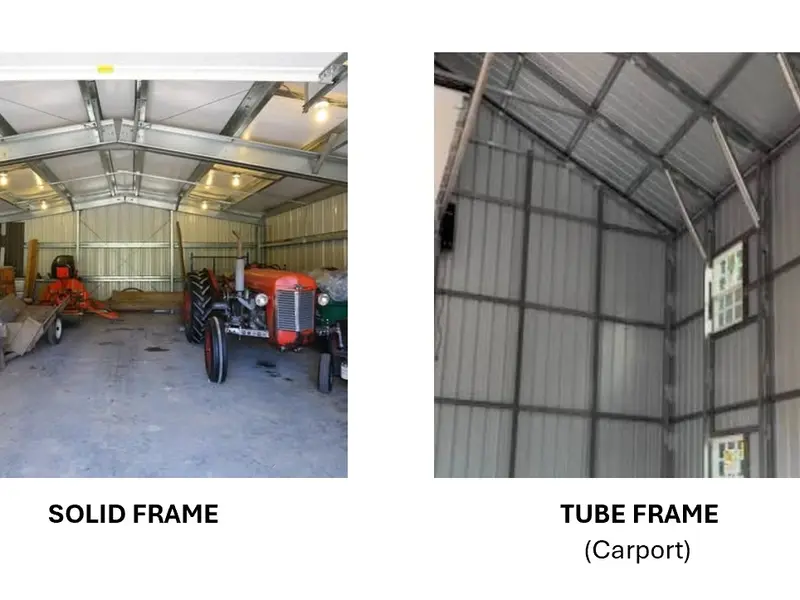
Yes, and this is worth knowing before you assume any building can be insulated the same way. Solid-frame construction — C-channel or I-beam — is generally built heavy enough to support interior finishes and insulation. Tube-frame buildings are a different story: the framing is lighter and typically not designed to carry the added weight of insulation and interior finish materials the way solid-frame construction is. If you know you want a conditioned, insulated space, that is one more reason solid-frame is the right starting point — see our solid frame vs. tube frame article for the full structural comparison.
Vapor barriers: do not skip this if you insulate
Any insulation package in a conditioned building needs a properly installed vapor barrier to prevent condensation from forming inside the wall or roof assembly. Skipping it, or installing it with gaps and punctures, is one of the most common insulation mistakes we see — it can lead to trapped moisture, mold, and coating damage on the inside of your panels over time. This applies above the slab too, not just inside the walls; our concrete slab article covers the under-slab vapor barrier specifically.
Get insulation quoted alongside your building, not after
Because insulation is priced separately from your delivered building, it is worth deciding early whether you want it — that decision can affect your secondary framing spacing and your interior finish plans, which is easier to account for before your drawings are finalized than after. For what belongs on a complete quote in general, see our article on what’s included in a steel building quote. If you want help deciding what makes sense for your project, call us at (888) 460-9294 or email estimating@northcraftsteel.com.