
Church Steel Buildings in Charlotte, Engineered to Mecklenburg County’s Real Code and Loads
Column-free sanctuaries, fellowship halls, and multi-purpose campus buildings for congregations across Charlotte and the surrounding Carolinas.
Built for decades. Backed in writing.
50-Year Paint Warranty, 50-Year Rust Perforation Warranty, 60-Year Structural Warranty, and Lifetime Warranty on Hardware — all transferable to the next property owner.
Get Your Customized Quote
- No obligation — we’ll send the price, not a salesperson to your door.
- Engineered drawings stamped for your state.
- 60-Year Limited Structural, 50-Year Limited Paint, 50-Year Limited Rust Perforation, and Lifetime Limited Hardware warranties.
- Delivered nationwide, all 50 states.
Custom Engineering • Any Dimension • Code Compliant • Nationwide Delivery
Serving Churches in Charlotte and the Surrounding Carolinas
Northcraft Steel serves churches in Charlotte, Concord, Huntersville, Mooresville, Matthews, Mint Hill, Kannapolis, Gastonia, Indian Trail, Fort Mill, and Rock Hill, and surrounding communities.
Church Steel Building Price
$27,800 and up
C-channel framing, 10’ eave height basis, standard snow and wind loads.
Ranges from a 40x60 C-channel sanctuary or fellowship hall to a 50x100 I-beam campus building — buildings 50' wide and up move to I-beam framing on a 12' eave basis.
Included
- • Stamped, engineered building drawings for your state
- • All primary building components
- • Freight to your site
Not included
- • Doors and windows
- • Insulation
- • Concrete or foundation work
- • Erection
Building specs
- • Framing type: C-channel solid frame, 10-16 gauge steel
- • Roof / wall panels: 26-gauge and heavier available
- • Roof pitch: Up to 8/12
- • Coating: Galvalume AZ55 on all primary and secondary framing
- • Hardware: Stainless steel hardware with a neoprene washer
- • Trim package: Full trim package included
What moves the price
- • Eave height above the 10’ basis
- • Ground snow load above 35 psf
- • Wind load above 110 mph
- • Areas with high seismic activity
This is a starting price, not a binding quote — your exact number depends on your state’s code requirements, site conditions, and what the building has to carry. We confirm the real number with stamped engineering before you sign anything.
Churches that are Designed for Ministry
Common sizes matched to typical use cases — a starting point for scoping your engineered building.
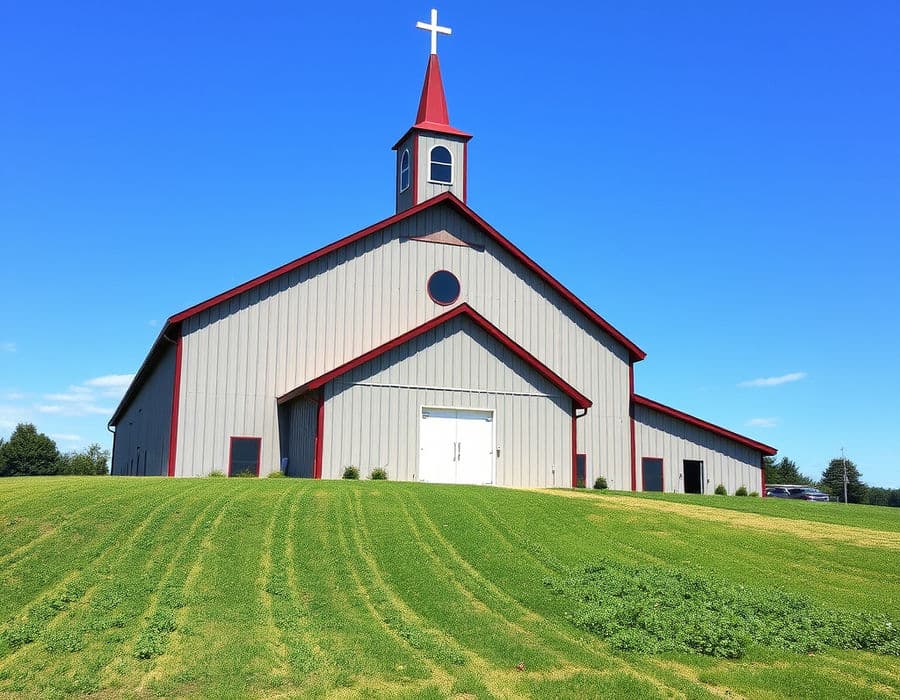
Sanctuaries
Open, column-free worship spaces free of interior support posts, so every seat has a clear sightline to the front.
Fellowship Halls
Multi-purpose gathering spaces for meals, events, and community outreach — clear span flexibility for any configuration.
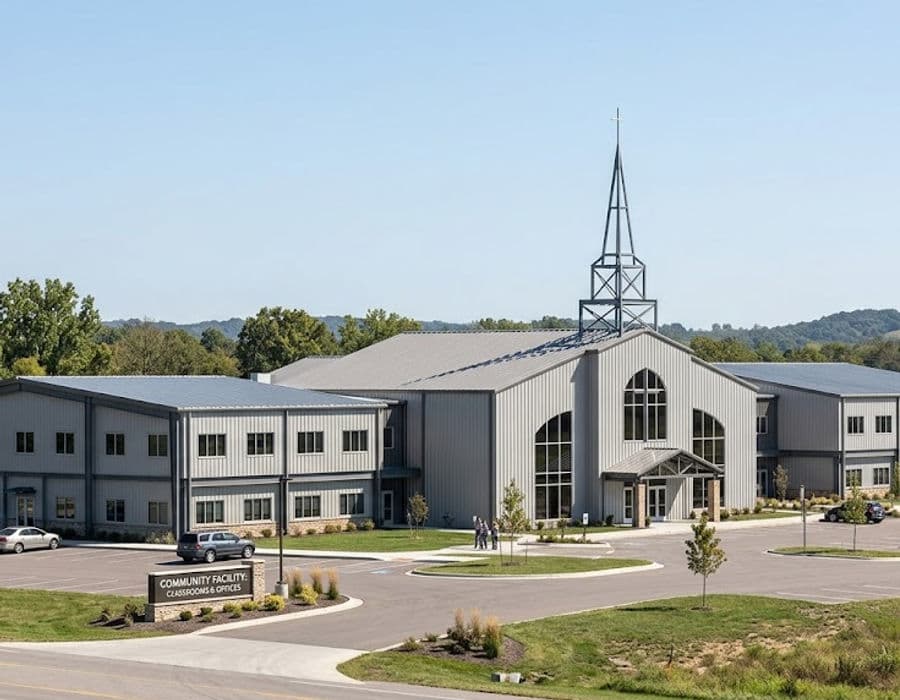
Classrooms & Offices
Add mezzanine or wing classrooms, administrative offices, and meeting rooms engineered to your floor plan.
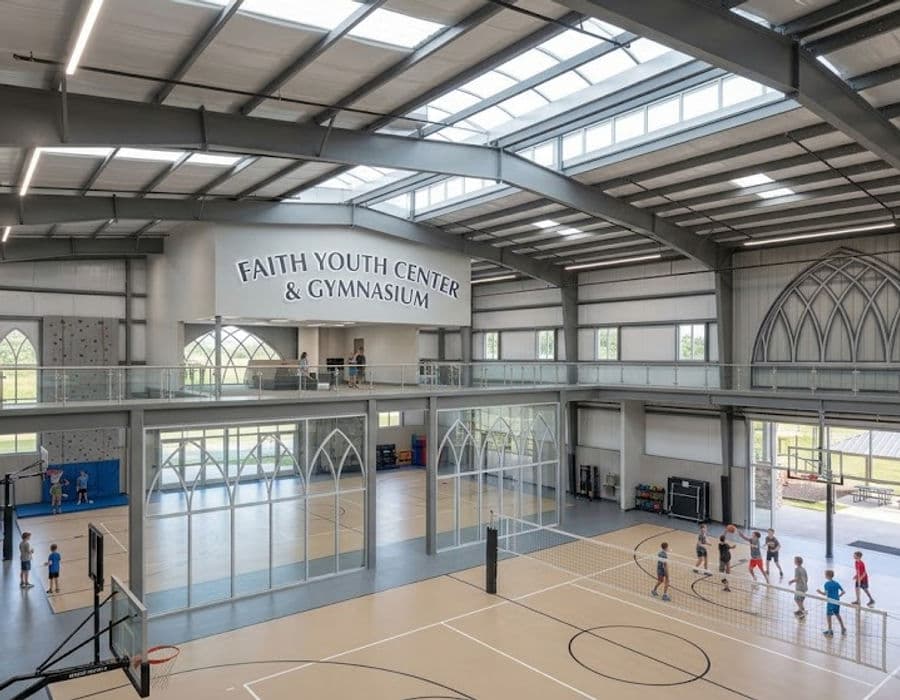
Gymnasiums & Youth Centers
Full-size gymnasiums and youth facilities with high clearances for basketball, volleyball, and community recreation.
North Carolina’s Code, and What It Means Locally
North Carolina isn’t building under a re-badged version of another state’s rules, and it isn’t static either. The 2018 North Carolina State Building Code (based on the 2015 IBC, referencing ASCE 7-10 per the NC Office of the State Fire Marshal’s own formal interpretation) has been the code of record for several years, and the state’s Building Code Council adopted a 2024 edition in early 2025 for phased rollout. Confirm which edition Mecklenburg, Cabarrus, or your specific county is currently enforcing with your local plans examiner — that’s a real local variable a nationwide page can’t settle for you.
Seismic: Low Here, But Quote the Edition Your Examiner Uses
North Carolina’s enforced 2018 code references ASCE 7-10, and a live USGS query for Charlotte at Site Class D returns Seismic Design Category C under that edition. The newer ASCE 7-16 and 7-22 both return the lower Category B for the same point. We quote C, because that is the edition your plans examiner applies. What genuinely does not change is the risk category — Charlotte returns the same category at Risk Category II and at Risk Category III, so a larger sanctuary is not pushed into a higher seismic class by occupancy alone. Seismic isn’t what separates a large Charlotte-area sanctuary from a same-site commercial building; wind is.
Wind: Where Risk Category Actually Moves the Number
North Carolina enforces a code referencing ASCE 7-10, and that edition’s own wind maps put Charlotte at 115 mph for Risk Category II and 120 mph for Risk Category III — the category a sanctuary or fellowship hall enters once its largest single room seats more than 300 people (see Northcraft’s national church page for the full explanation). Both sit above Northcraft’s published 110 mph basis, so plan on the wind factor applying either way. The newer ASCE 7-16 maps return lower numbers for this same point — about 111 and 119 mph — which is exactly why we quote the edition your plans examiner applies rather than the newest one published.
Snow: Real, but Rarely the Deciding Factor Here
ASCE’s own snow-load data returns about 10 psf ground snow load for the Charlotte coordinates above — well under Northcraft’s 35 psf standard basis — and Charlotte doesn’t fall inside a mapped case-study area requiring a site-specific snow study, unlike parts of the North Carolina mountains to the west. For a Charlotte or Piedmont project, wind and occupancy are the local variables worth planning around; snow generally isn’t.
From Engineering to Erecting
A streamlined three-phase process takes your church steel building from blueprint to standing structure.
STEP 1
Engineering & Fabrication
Every component is CAD-engineered to your specs and factory-fabricated to exact tolerances before it ships.
STEP 2
Concrete Foundation
A poured concrete foundation is prepared on your site to the engineered plan, ready to receive the steel frame.
STEP 3
Steel Erection
Pre-cut, pre-drilled components bolt together quickly — no welding in the field, no guesswork on the ground.
Backed By Real Warranties

YEAR LIMITED RUST WARRANTY

YEAR LIMITED PAINT WARRANTY

YEAR LIMITED STRUCTURAL WARRANTY

LIMITED HARDWARE WARRANTY
All four warranties are transferable to the next property owner. Every building ships with code-compliant stamped engineering for the delivery state. See full warranty terms.
* Warranty coverage is subject to applicable warranty terms, conditions, limitations, and exclusions. Complete warranty details are provided during the purchase process and included within the applicable purchase documentation.
Frequently Asked Questions
What does a church steel building cost in North Carolina?
Northcraft's published floors for the sizes that fit most churches start at $27,800 (a 40x60 sanctuary or fellowship hall), delivered, and scale up in size through a 50x100 multi-purpose campus building — the same nationwide floors, plus North Carolina's own wind and seismic factors where they apply. Your estimator confirms the exact number for your site.
Does North Carolina's coastal wind zone change the price?
It can. Charlotte and the Piedmont sit well inland of North Carolina's coastal high-wind zone, so most projects here fall under Northcraft's standard 110 mph wind basis. A site closer to the coast may carry a higher wind rating, which is one of the published factors that moves the price.
Do I need a permit for a church building in Mecklenburg County or the surrounding counties?
Most jurisdictions require a permit for an assembly building like a church, and many add extra occupancy or fire-code review beyond a standard commercial permit — this applies across Mecklenburg, Cabarrus, and the other counties we serve. We provide the stamped engineering drawings your local building department and fire marshal will ask for.
Can the building be customized for our congregation's exact layout?
Yes — a growing Charlotte-area congregation rarely fits a preset floor plan. Bring your sanctuary seating count, classroom wing needs, or your architect's drawings, and we engineer to those specifications rather than a catalog size.
What's included in the price, and what isn't?
Included: stamped engineered drawings for North Carolina, every structural and panel component, and freight to your site. Not included in that base price: doors and windows, insulation, and foundation and erection — those are priced separately; foundation and erection services are available — ask your estimator.
How long does delivery take to the Charlotte area?
Typically 45-60 days from order to delivery, depending on engineering review and current production volume, the same nationwide timeline. Your estimator confirms a real date range once your drawings are finalized.
Can our congregation finance a new building?
Northcraft does not broker or arrange financing. Congregations in the Charlotte area typically use a denominational lending program, a local or regional bank construction loan, or a capital campaign — ask your estimator what's worked for others nearby.
What building code edition applies to a church project in the Charlotte area right now?
North Carolina has been mid-transition: the 2018 North Carolina State Building Code (based on the 2015 IBC, referencing ASCE 7-10 per the NC Office of the State Fire Marshal's own formal interpretation) has been the code of record for several years, and a 2024 edition was adopted by the state's Building Code Council in early 2025 for phased rollout. Confirm which edition Mecklenburg County or your specific county is enforcing with your local plans examiner before your engineering package is finalized — that's a local determination no nationwide page can make for you.
Does Charlotte's seismic risk change for a larger sanctuary (Risk Category III)?
Not much — and the edition matters more than the risk category here. Under ASCE 7-10, the edition North Carolina's enforced 2018 code references, a live USGS query for Charlotte at Site Class D returns Seismic Design Category C. Under the newer ASCE 7-16 and 7-22 the same point returns the lower Category B. We quote C, because that is the edition your plans examiner applies. What does NOT change is the risk category: Charlotte returns the same SDC whether the calculation runs at Risk Category II or III, so a large sanctuary is not pushed into a higher seismic class by occupancy alone. Wind, not seismic, is the load factor that actually separates a large Charlotte-area sanctuary from a same-site commercial building.
Does a large Charlotte-area sanctuary need a higher wind rating than Northcraft's standard 110 mph basis?
Yes, and by more than the newest maps suggest. North Carolina enforces a code referencing ASCE 7-10, and that edition's own wind maps put Charlotte at 115 mph for Risk Category II and 120 mph for Risk Category III — the category a sanctuary or fellowship hall enters once its largest single room seats more than 300 people. Both sit above Northcraft's published 110 mph basis, so plan on the wind factor applying either way. The newer ASCE 7-16 maps return lower figures for the same point (about 111 and 119 mph), which is why we quote the enforced edition rather than the newest one — quoting 7-16 here would understate what your plans examiner actually requires. Tell your estimator your expected seating count so this gets checked for your specific site.
Related Pages
- Church Steel Buildings in North Carolina — statewide code, wind & snow detail
- Steel Buildings in North Carolina — the general statewide engineering guide, every building type
- Church Steel Buildings — the full nationwide guide
- Metal Churches — a deeper look at price, FAQ, and trust detail
- 40x60 Steel Building — a common sanctuary or fellowship hall size
- 50x100 Steel Building — multi-purpose campus scale
Build Your Church Steel Building Right.
Buy once. Build it right. Get a custom-engineered quote for your custom church steel building — no obligation.
Call: (888) 460-9294 | Email: Estimating@Northcraftsteel.com
Get Your Customized Quote